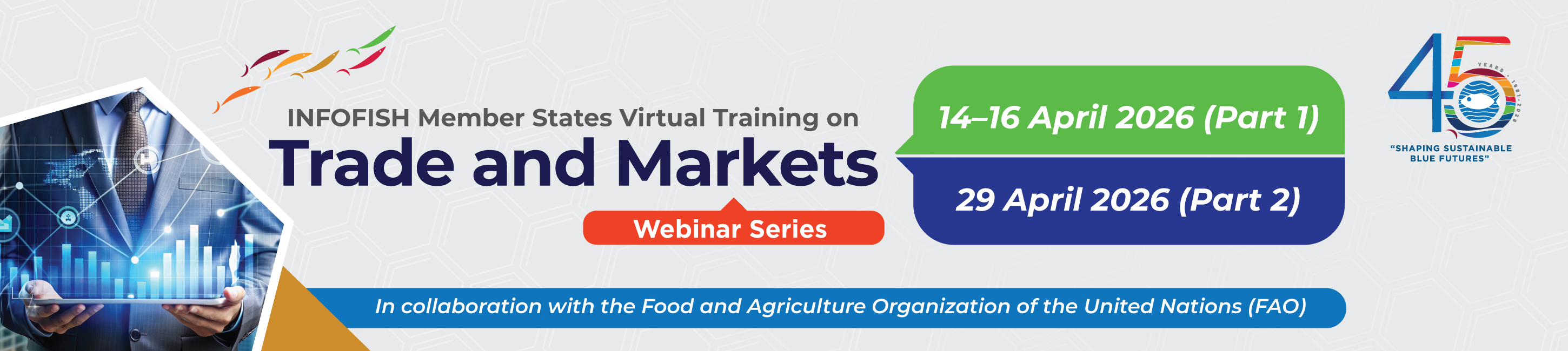
INFOFISH, in collaboration with the Food and Agriculture Organization of the United Nations (FAO), is organizing a webinar series and training programme titled “Current Trade and Markets 2026.”
This training module will feature presentations by FAO technical experts across various areas of the fisheries sector. It aims to provide participants with a comprehensive overview of current global trade and market trends from both regulatory and technical perspectives, as well as deeper insights into key developments in international fisheries trade.
Registration for Part 2 of the webinar is now open, and participants are encouraged to complete their registration at their earliest convenience.
Tentative Program
| Time (Malaysia - GMT+8) | Subject | Resource Person/s |
| 14:00 | Zoom line open | INFOFISH |
| 14:45 - 15:00 | Welcome Remarks and Brief Introduction | INFOFISH |
| 15:00 – 16:00 |
The Value of Small-Scale Fisheries in Production and Trade and the Importance of the FAO Voluntary Guidelines for Securing Sustainable Small-Scale Fisheries Presentation of securing sustainable SSF through the implementation of the SSF Guidelines and social protection as an economic inclusion dimension. |
Mele Tauati and Alison MacNaughton |
| 16:00 – 17:00 |
Best Practices in port operations, including IUU Fishing implementation of the Port State Measure (PSMA) The session highlights how combating IUU fishing has become a prerequisite for access to certain international markets. It will examine the FAO Agreement on Port State Measures (PSMA), the IPOA-IUU, Voluntary Guidelines on Catch Documentation Schemes (VG-CDS) and Transshipment (VG-TS), and the International Plan of Action for the Management of Fishing Capacity (IPOA-Capacity) from a trade perspective and provide the relevance of effective national policies in reaping the benefits of market access opportunities. |
Esther Boy Carmona |
| 17:00 – 18:00 |
Blue Ports Initiative (BPI) The presentation will highlight the role of ports in coastal sustainability and identifying characteristics of Blue Ports, the important role of stakeholder engagement in the transformation into a Blue Port, the three-stage process of becoming a Blue Port as outlined in the FAO publication, Roadmap to a Blue Port. |
TBC |
| 18:00 – 18:30 |
Q & A |
Participants |
| Time (Malaysia - GMT+8) | Subject | Resource Person/s |
| 12:00 (noon) | Zoom line open | INFOFISH |
| 12:45 – 13:00 | Welcome Remarks and Brief Introduction | INFOFISH |
| 13:00 – 14:00 |
An Introduction Current Trends of Fisheries and Aquaculture Products – A Global Perspective To provide participants with a comprehensive overview of global fisheries and aquaculture products, including recent trends, leading players, primary commodities, trading patterns, and the importance of small-scale fishers and developing countries as producers, among other topics. |
Marcio Castro de Souza |
| 14:00 – 15:00 | Basic Principles Applicable to Global Fish Trade The fundamental concepts related to international trade in fisheries and aquaculture products, such as non-discrimination, transparency, and predictability, will be presented pragmatically, emphasizing their importance in ensuring fair trade practices and flows. | Bhakti Anand |
| 15:00 – 15:30 |
The Main Global Instruments The leading global instruments related to fisheries from a trade perspective. The instruments will be presented to show their impact and interconnectedness with the trade of fisheries and aquaculture, focusing on clauses related to international obligations and compliance requirements. Some instruments to be analyzed are the United Nations Convention on the Law of the Sea (UNCLOS), the WTO Agreements from a fisheries and aquaculture angle, and the Fish Stock Agreement. |
Marcio Castro de Souza |
| 15:30 – 16:00 |
FAO Instruments To present the FAO's primary fish instruments, highlighting their goals and general characteristics, focusing on their support for international trade in fisheries and aquaculture products. In addition, the primary areas of the FAO Fisheries and Aquaculture Division will be outlined. Among the FAO instruments to be analyzed there will be the FAO Code of Conduct for Responsible Fisheries, the International Plans of Action (IPOAs), the Voluntary Guidelines for Securing Sustainable Small-Scale Fisheries (the SSF Guidelines), the FAO Agreement on Port State Measures (PSMA), the FAO Voluntary Guidelines for Catch Documentation Schemes (CDS), the FAO Technical Guidelines on Aquaculture Certification, the FAO Guidelines for the Ecolabelling of Fish and Fishery Products from Inland Capture Fisheries, and the FAO Guidelines for the Ecolabelling of Fish and Fishery Products from Marine Capture Fisheries. |
Marcio Castro de Souza |
| 16:00 – 16:30 |
Q & A |
Participants |
| Time (Malaysia - GMT+8) | Subject | Resource Person/s |
| 14:00 | Zoom line open | INFOFISH |
| 14:45 - 15:00 | Brief Introduction | INFOFISH |
| 15:00 – 16:00 |
Transparency, Traceability, and Certification of Fisheries and Aquaculture Products Explanation of the importance of transparency in government policies affecting fisheries and aquaculture to improve market access and compliance with present and future international instruments. Inform on market and sustainability standards related to the value chain of fisheries and aquaculture products, including certification schemes. The main FAO supporting instruments to promote private and public compliance and implementation initiatives are discussed. |
Nada Bougoss |
| 16:00 – 17:00 |
The WHO/FAO Codex Alimentarius Standards and Guidelines Presentation of the WHO/FAO Codex Alimentarius standards and guidelines, the role played by FAO, and the associated main instruments addressing fisheries and aquaculture products. |
Esther Garrido Gamarro |
| 17:00 – 18:00 |
The Basic Food Safety Requirements of the Major Import Markets The primary food safety requirements of the major import markets will be presented, together with an assessment of the primary causes of border rejections in selected markets |
Esther Garrido Gamarro / Giulia Loi |
| 18:00 – 18:30 |
Q & A |
Participants |
| Time (Malaysia - GMT+8) | Subject | Resource Person/s |
| 14:00 | Zoom line open | INFOFISH |
| 14:45 - 15:00 | Brief Introduction | INFOFISH |
| 15:00 – 16:00 |
Food Loss and Waste in Fisheries and Aquaculture Value Chains The session examines the nature, magnitude and causes of food loss and waste along fisheries and aquaculture value chains. It highlights available tools and methodologies for assessing fish losses and reviews how countries report on measures to reduce post-harvest losses, improve handling practices, and promote the use of aquatic products for human consumption. The session also applies a multidimensional solutions approach to address loss and waste holistically. Particular attention is given to the differentiated impact of food loss on small-scale operators, especially in developing countries where inadequate cold chain infrastructure, limited access to energy and poor transport conditions contribute to higher loss rates. |
Omar Penarubia, Ansen Ward and Mohammed Ichibane |
| 16:00 – 17:00 |
Fish Nutrition The session introduces the critical role of fish nutrition in sustainable aquaculture, highlighting how balanced diets, efficient feed use, and informed ingredient choices can enhance fish health, growth, and environmental performance. It will explore how effective nutrition strategies contribute to more resilient, resource-efficient, and sustainable aquatic food systems. |
Molly Ahern / Jogeir Toppe |
| 17:00 – 18:00 |
Bioeconomy Bioeconomy offers a powerful lens to rethink how we produce, use, and value biological resources in aquatic food systems. By turning waste into valuable products and applying innovation across the entire value chain, it enables more sustainable, circular, and inclusive approaches to fisheries and aquaculture. From transforming fish by-products into feed, fertilizers, or fashion materials, to designing resilient production systems, bioeconomy is unlocking new opportunities for economic growth while addressing pressing challenges such as resource scarcity, climate change, and food security. |
Lingyan Li |
| 18:00 – 18:30 |
Q & A |
Participants |