Article II 2/2026 - SOFT-SHELL MUD CRAB FARMING IN BANGLADESH: CHALLENGES AND PROSPECTS
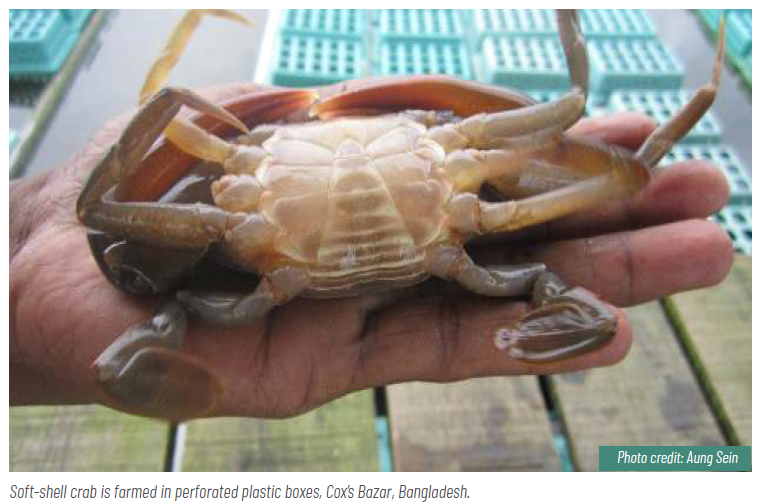
Soft-shell crabs are considered a delicacy by many seafood consumers. Unlike regular crab harvesting, soft-shell crab farming involves rearing hard-shell crabs in controlled brackish water conditions and monitoring them carefully so they can be harvested at the precise moment immediately after moulting, when their new shells are still soft. This stage lasts only a few hours, making the timing of harvest critical. At this stage, the crabs fetch higher prices in export markets compared to hard-shell crabs, thanks to their delicate texture and juicy flavour.
The beginnings of the industry
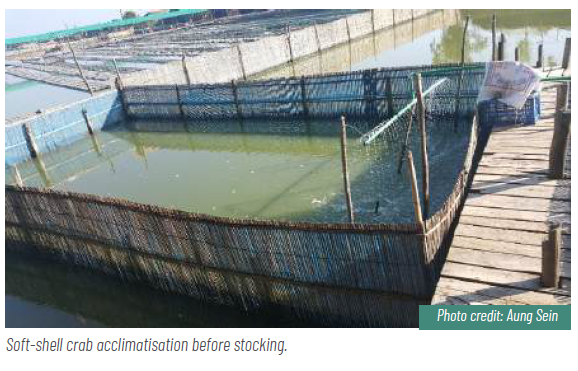
The shift towards soft-shell crab farming
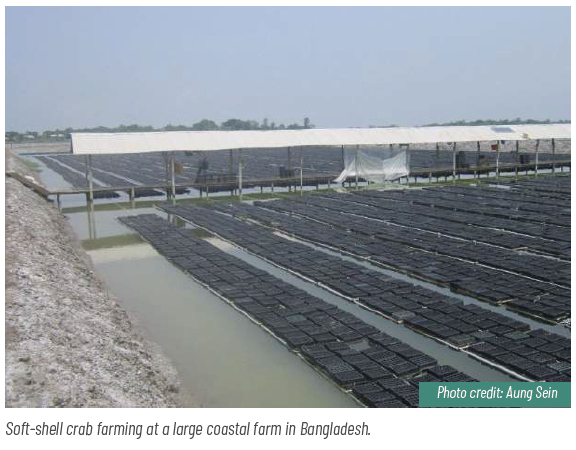
Previously, soft-shell crab farming was concentrated around Cox’s Bazar (southeast region) but for the last five years it has become more prevalent in Shyamnagar, Munshiganj Upazila, in Satkhira District (southwest region). This is due to the natural abundance of crablets, juveniles and sub-adults in the adjacent Sundarbans mangrove areas. This region has now become the national hub for soft-shell crab production and is home to thousands of small-scale soft-shell mud crab farms, together with some larger farms.
Economic importance
Local consumption of hard-shell crabs is restricted mainly to the tribal and minority communities. Consequently, Bangladesh is a significant exporter of hard-shell crabs, with the soft-shell variety constituting a new addition to the country’s wide range of aquaculture commodities. According to the Export Promotion Bureau, Bangladesh exported frozen crab worth USD 12.3 million in 2020–21, destined for China, the United States, and parts of Asia and Australia. In subsequent fiscal years, mud crab shipments from Bangladesh rose significantly from 644.77 tonnes in 2023–24, to about 1 166.89 tonnes in 2024–25. Meanwhile, export value increased from about USD 8 million to over USD 14 million, showing strong international demand6. However, it is important to mention that the available data does not distinguish between hard-shell and soft-shell mud crab exports. The major markets for soft-shell crabs are Japan, the Democratic People’s Republic of Korea, Europe, the United States, and ASEAN countries.
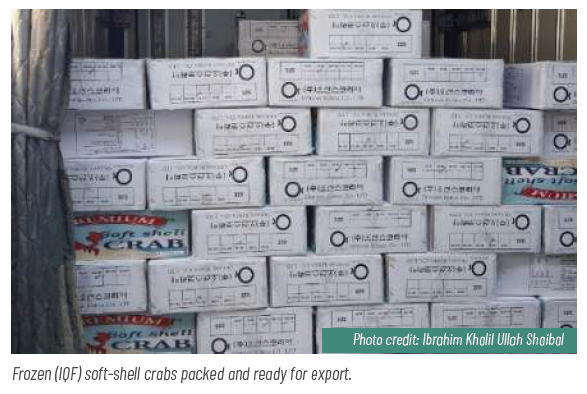
Soft-shell crab farming contributes significantly to foreign exchange earnings and employment. Currently, the sector directly supports about 10 000 people, offering employment in farming, processing, and supply chain operations. Women and youth contribute to daily monitoring activities at the farm level and in the factories through handling and processing activities.

Soft-shell crab farming: Step-by-step guidelines
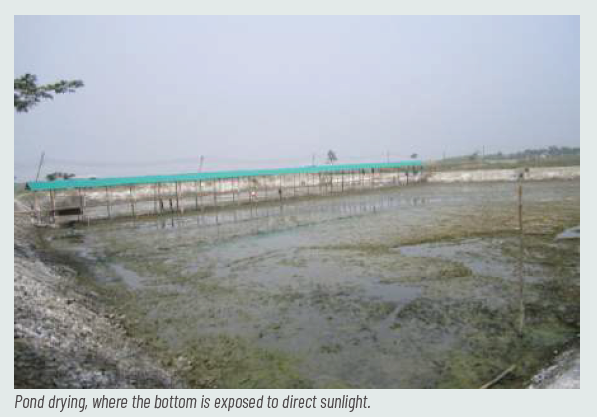
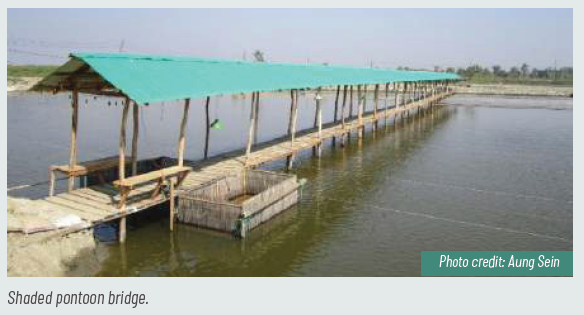
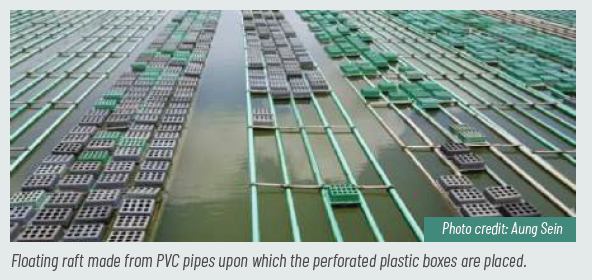
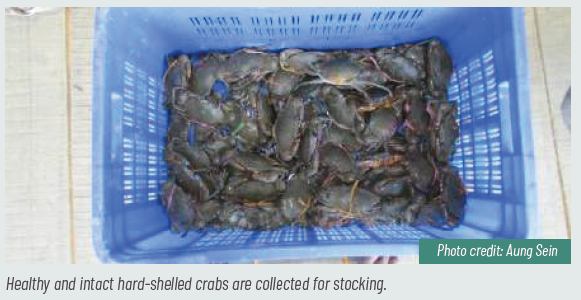
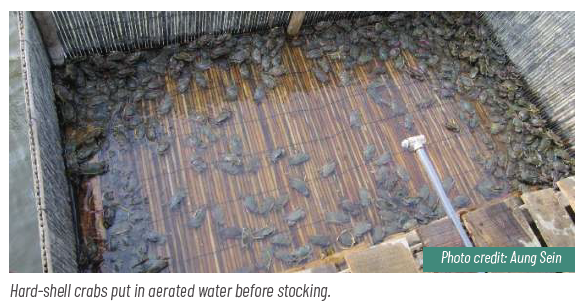
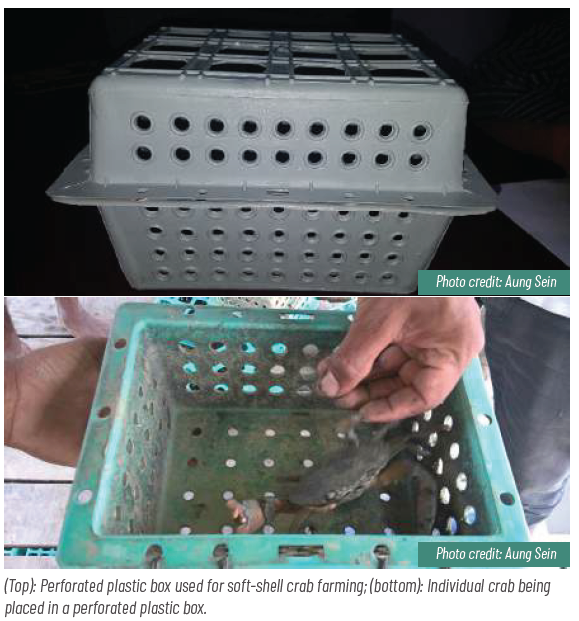
• Salinity: Coastal tidal water with a salinity reading of 15–30 ppt is suitable for soft-shell crab farming.
• Temperature (°C): As the farming is done in outdoor ponds, temperature depends on natural seasonal changes. Experience shows that extremely high temperatures in summer lead to higher mortality. However, the moulting rates are lower in the winter season.
• Water quality management: The pond water is regularly exchanged with tidal water to maintain optimum brackish water conditions. Generally, no additives are applied to the pond water; however, lime (calcium carbonate and dolomite) is useful to optimise pH and mineral content during the rainy season.
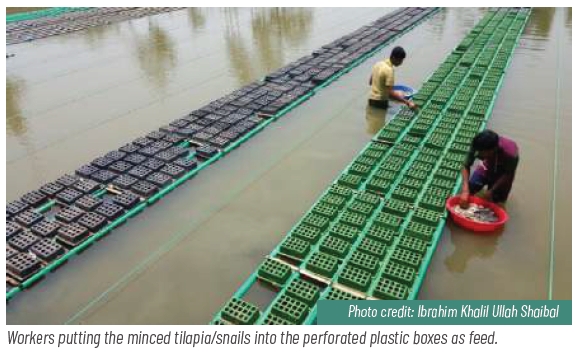
4) Feeding practices
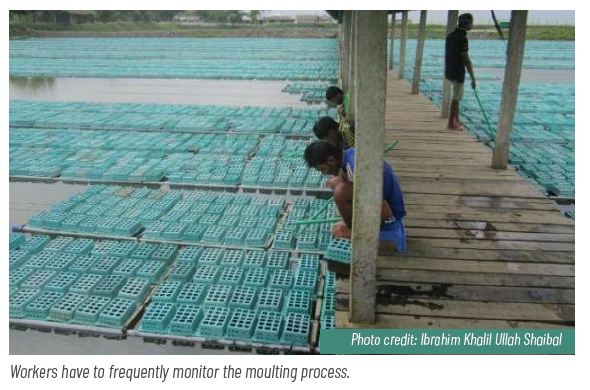
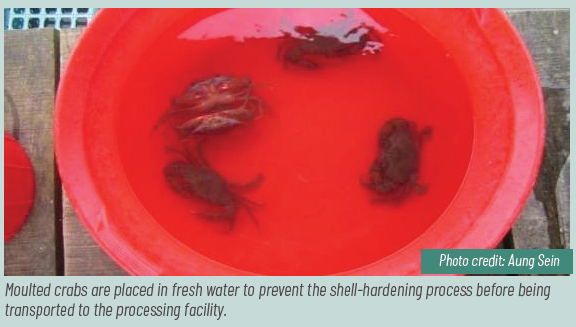
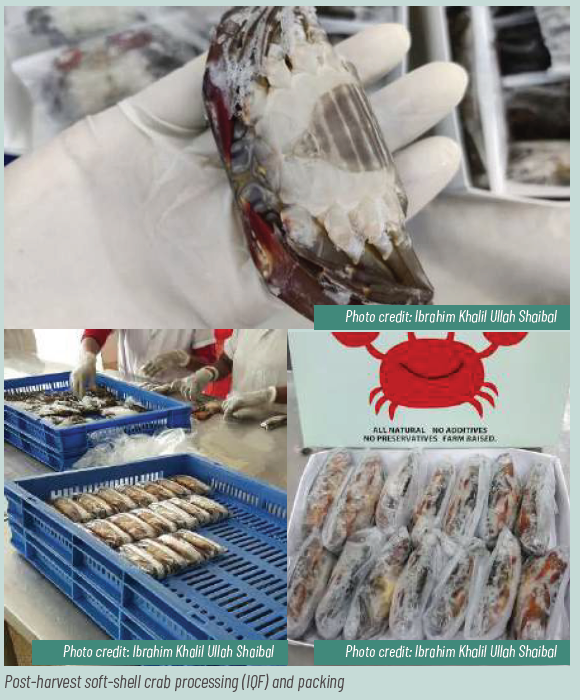
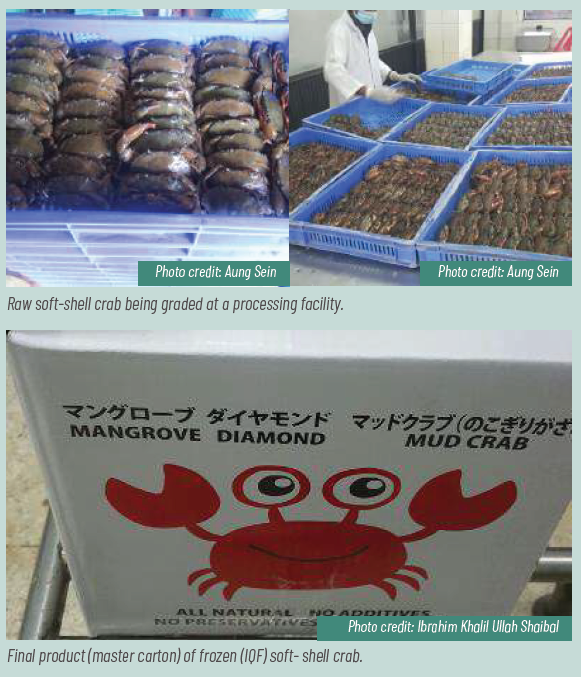
There is little demand for soft-shell crabs in the domestic market. Generally, farmers sell the C-grade crabs (missing most of the legs and comprising about 5% of supply) to local suppliers, who sometimes sell these to local consumers. A-grade (with complete legs; 70%) and B-grade (missing some legs; 25%) products are sold to processing factories for export. The price of soft-shell crabs is higher than hard-shell crabs7, and the value chain is relatively shorter.
Many farmers sell soft-shell crabs to nearby processing factories, where they are prepared for export markets in line with international food safety standards and compliance. Major markets include the Republic of Korea, Japan, Europe, the United States and ASEAN countries where soft-shell crabs are considered premium seafood items. Soft-shell crabs are widely consumed as stir-fried, mixed with fried rice, and in sandwiches and noodles.
Challenges and constraints
- Dependency on wild crab stock
There is no fully operational and commercial mud crab hatchery in the country to produce megalopa larvae or crablets. Currently, crablets, juveniles and sub-adult crabs are being collected from the wild. This has put immense pressure on wild crab stock, creating challenges for long-term environmental sustainability and consistent supply chains.
- Regulatory issues and seasonal fishing bans
A 65-day marine fishing ban (April–June) imposed by the Department of Fisheries, and a two-month ban on crab harvesting by the Department of Forestry (generally January and February, which is considered the peak breeding season for crabs) hamper the livelihoods of the coastal communities who are dependent on these fisheries. On the other hand, over-exploitation of wild crabs and declining natural stocks are also threats to the biodiversity and sustainability of the aquaculture sector.
- Technical and quality issues
Soft-shell crab farming requires careful monitoring and handling, as even a small oversight in timing leads can disrupt moulting cycles. Poor water quality can lead to mortality, and small-scale holders often lack knowledge of proper handling and processing. Hence, factories face major difficulties if quality and standards are not maintained as per export requirements.
- Market access and price fluctuation
Although export markets are lucrative, volatility in export prices and barriers to market access (e.g. buyers preferring large quantities with consistent supplies) can reduce farmers’ profit margins. As soft-shell crabs have little demand in the domestic market, farmers are highly dependent upon international buyers and export markets.
- Natural calamities and climate-induced risks
Intensified cyclones, tidal surges, flooding and erosion threaten coastal livelihoods every now and then, and present economic risks to farmers through damage to pond dykes, cages and infrastructure.
Prospects and specific recommendations
- With targeted investment in the establishment of commercial crab hatcheries, soft-shell crab farming will emerge as a sustainable alternative for the aquaculture sector.
- Enabling policies for the development of hatchery infrastructure and farms will minimise dependency on wild crab stocks, restore natural populations, and maximise production through a sustainable supply of crablets, juveniles and sub-adult crabs.
- Capacity-building of technical staff and farmers through training could improve the quality and safety of soft-shell crabs, as well as boost production.
- Strengthening investment through public-private partnerships could add value to supply chains including improvements in farming, processing and packaging. It will also help in meeting international quality and safety standards, thus ensuring wider market access.
- The National Framework and Action Plan for Locally-Led Adaptation (LLA) launched recently in Bangladesh should include fisheries and aquaculture to boost climate resilience and mitigate climate-induced risks.
Conclusion
More references
-
Ibarra, L.E.E., Olivas., E., Partida, A.L. and Paredes. D. 2015. Generation of Added Value Through the Process of Sof Shell Crab: A Sustainable Development Option in the Coastal Region of Sonora. Journal of Management and Sustainability 5, no. 2: 57-68. http://doi.org/10.5539/jms.v5n2p57.
-
Gao, W., Yuan., Y. and Huang, Z. et al., 2023. Evaluation of the Feasibility of Harvest Optimisation of Soft-Shell Mud Crab (Scylla paramamosain). From the Perspective of National Values. Foods 12, no. 3: 1-16. http://doi.org/10.3390/foods12030583.
-
Haque, M.M., Sarker., A., Saha., S., Islam., A.M.R., Islam., S.N., and Baki., M.A., 2025. Assessment of Soft-Shell Mud Crab (Scylla olivacea) Farming Trend in the Southwest Coastal Region of Bangladesh. Aquaculture, Fish and Fisheries 2025: 5: e70045. https://doi.org/10.1002/aff2.70045. Cross Ref.
1 FAO. 2024. The State of World Fisheries and Aquaculture 2024 – Blue Transformation in action. Rome.
https://doi.org/10.4060/cd0683en
2 DOF 2024. 2024 Yearbook of Fisheries Statistics of Bangladesh, 2023-24. Fisheries Resources Survey
System (FRSS), Department of Fisheries; Ministry of Fisheries and Livestock, 2024. Volume 41; 140p.
4c64d1e387d446ec97430228bcc06ddc.pdf
3 Rouf, M.A., I.M., Shahriar., S.I.M., Sarower, M.G., and Ahsan, M.N., 2016. Taxonomic Clarification of Mud Crab
Species of Genus Scylla (Brachyura: Portunidae) Available in the Coastal Regions of Bangladesh. Asian
Fisheries Science 29 (2016):124-136. https://doi.org/10.33997/j.afs.2016.29.3.001
4 The Sundarbans, The Sundarbans - UNESCO World Heritage Centre
5 The Sundarbans Reserved Forest, https://rsis.ramsar.org/ris/560
6 Export Promotion Bureau, Bangladesh.
7 Tavares, C. P. S., U. A. T. Silva, L. Â. Pereira, and A. Ostrensky. 2021.Evaluation of Different Induced Molting Methods in Callinectes ornatus (Crustacea, decapoda, portunidae) as a Tool for the Commercial Production of Soft-Shell Crabs.” Anais Da Academia Brasileira De Ciencias 93, no.2: 1–14. http://doi.org/10.1590/0001-3765202120190580
ADVERTISEMENTS