Article II 2/2026 - INNOVATION IN ARID ENVIRONMENTS: BUILDING RESILIENT AND SUSTAINABLE AQUACULTURE IN SAUDI ARABIA
Inland aquaculture remains a pillar of national food security, with tilapia production reaching approximately 45,200 tonnes in 2023, representing nearly 32% of total national output. North African catfish (Clarias gariepinus) follows as the second-largest freshwater species at 1,230 tonnes. These inland operations remain essential for rural development and stabilising the domestic food supply.
Aquaculture challenges in Saudi Arabia
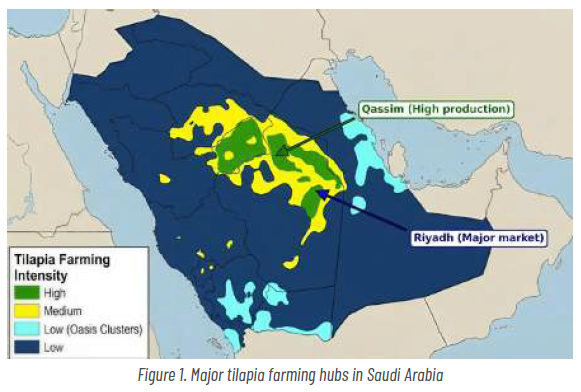
The Saudi aquaculture industry faces significant hurdles, including limited natural resources, a scarcity of high-quality broodstock, inadequate site selection, a shortage of skilled personnel, and biosecurity threats. While Saudi Arabia’s interior is often perceived as a barren desert, the reality is that arable land accounts for only 1.8% of the country’s total area. The scarcity of surface and groundwater further intensifies this challenge. Currently, the agricultural sector consumes over 80% of the nation’s water (primarily from deep aquifers) severely constraining aquaculture expansion. Consequently, tilapia farms are concentrated in Al-Qassim and the regions surrounding Riyadh, where freshwater is more readily available. As illustrated in Figure 1, production volume and farm density decrease progressively toward coastal areas.
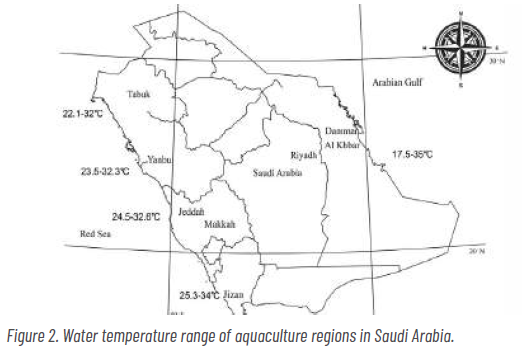
Environmental constraints extend to the coastline, where seawater salinity typically ranges from 42‰ to 45‰, which is significantly higher than the ideal larviculture range of 10‰ to 33.5‰. High water temperatures, fluctuating between 17.5°C and 35°C, further limit species suitability and operational feasibility (Figure 2). Beyond these natural factors, strict government regulations on well drilling and groundwater extraction make freshwater a high-cost component. The combined burden of hypersalinity and water scarcity remains a primary bottleneck for the industry.
The industry structure also presents unique challenges. Unlike the mariculture sector, which is dominated by a few mega-companies, the freshwater sector consists of approximately 350 small-scale, scattered farms. Before the 2010s, the Ministry of Environment, Water, and Agriculture (MEWA) struggled to monitor these operations due to the absence of standardised guidance and the fragmented distribution of facilities. Ineffective farm management often resulted in inconsistent product quality, unreliable production estimates, and compromised disease prevention measures.
Seedstock and seed dependency
Saudi Arabia’s marine finfish sector remains heavily dependent on imports of fingerlings from Bahrain, Türkiye, and Mediterranean countries, limiting species diversification and product development. This reliance on imported eggs and larvae stems from a localised inability to produce sufficient high-quality juveniles. Even in the tilapia sector, the quality and quantity of broodstock remain insufficient for most local hatcheries, resulting in a persistent shortage of qualified juveniles for domestic farms.
Human capital and infrastructure
Due to the industry’s relatively short history, there has been a chronic shortage of experienced farm management personnel. During the 1990s and 2000s, recruiting and training local talent was a significant challenge, exacerbated by a lack of specialised vocational training organisations. Coupled with the high capital expenditure required for production facilities in such extreme environments, these factors have historically hindered the sector’s competitive growth.
Strategic frameworks for resilience and sustainable growth
Since 2018, the Ministry of Environment, Water and Agriculture (MEWA) has accelerated aquaculture development through Saudi Arabia’s national transformation programs, specifically Vision 2030 and the Sustainable Rural Agricultural Development Program (REEF). These initiatives are designed to establish robust food security and sustainability strategies across the environment and agriculture sectors. Under these frameworks, MEWA has successfully integrated governmental, private, and academic resources to catalyse improvements in technology transfer, farm management, workforce training, disease prevention, and market access.
To safeguard finite groundwater resources, MEWA has implemented a dual approach: rigorous monitoring and pumping quotas, coupled with the active promotion of Integrated Agri-Aquaculture (IAA) and aquaponic systems. Innovative initiatives, such as the cultivation of Azolla within aquaculture ponds as organic fertiliser and protein-rich feed, are also underway. Consequently, IAA practices have flourished in Al-Qassim, Al-Ahsa, and Riyadh. In these clusters, farmers utilise deep groundwater for tilapia rearing, subsequently repurposing the nutrient-rich effluent for crop irrigation. This synergy optimises water-use efficiency and enhances agricultural circularity.
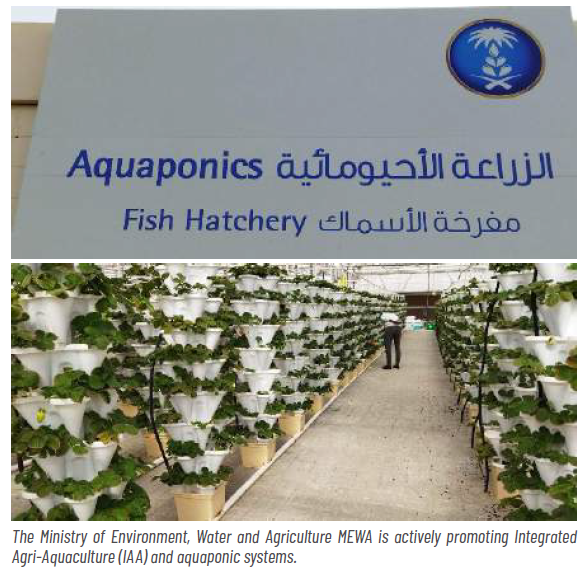
These regions represent two distinct paths toward sustainability: AlAhsa exemplifies the ‘Ecological Resilience’ model, rooted in historical oasis management and natural water discharge; conversely, Al-Qassim embodies the ‘Technological Optimization’ model, demonstrating how modern IAA practices, supported by stringent regulations, can mitigate the depletion of fossil aquifers. Together, these cases provide a comprehensive overview of the strategic adaptations within the Saudi aquaculture sector.
Marine Innovation and Socio-Economic Growth
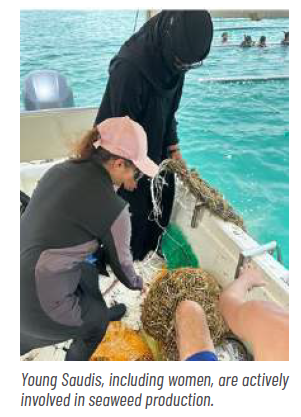
Regarding coastal operations, MEWA is actively encouraging the adoption of Recirculating Aquaculture Systems (RAS) to maximise water efficiency. The Ministry is also designating specialised aquaculture zones and diversifying cultivated species to streamline production. Along the coastline, new initiatives for seaweed and algae cultivation are being implemented to stimulate regional development. These strategic efforts aim to drive economic growth in coastal communities, fostering local engagement and creating long-term, sustainable employment opportunities.
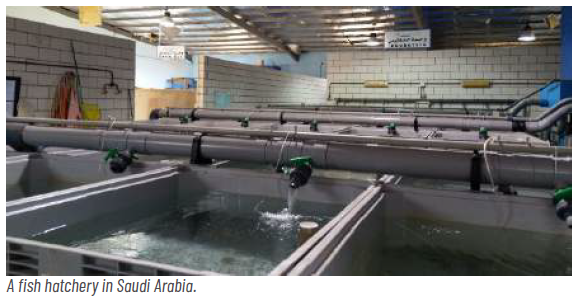
The stability of fry sources is fundamental to sustainable development; therefore, prioritising broodstock management is imperative. To address the current shortage of local supply, MEWA is prioritising the expansion of hatchery capacity. While Saudi Arabia has achieved commercial success with white shrimp, tilapia, Asian seabass, and gilthead bream, total output remains influenced by inherent environmental limitations, necessitating imports to meet high domestic demand. To mitigate disease risks and climate vulnerability, MEWA is pursuing the commercialisation of native species, such as snubnose pompano and sobaity seabream, to strengthen the sector’s long-term resilience.
Knowledge transfer and biosecurity protocols
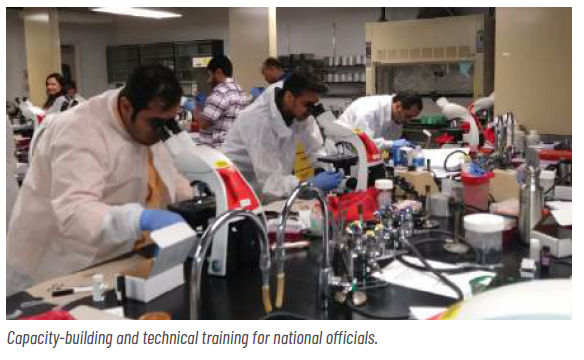
MEWA collaborates with local universities, international organisations, and national research centres to improve technology transfer. Through practical workshops and technical training, local professionals are enhancing their expertise to support the ongoing development of the national aquaculture sector. These centres offer technical assistance, consultation, and high-quality fry to farmers to elevate the standards of local operations. On the biosecurity front, MEWA regularly convenes industry leaders for seminars and maintains a rigorous national tracking system for aquatic diseases. Stringent regulations govern the import of live fish, restricting permits to licensed operators to prevent pathogen outbreaks. Furthermore, the Ministry provides farmers with comprehensive biosecurity manuals and conducts regular farm monitoring to ensure compliance.
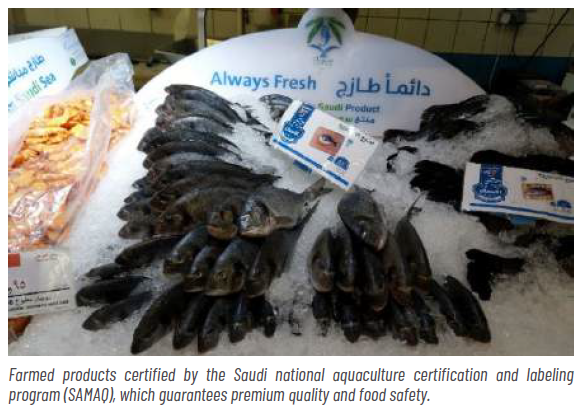
Beyond production, MEWA aims to increase annual per capita seafood consumption from the current 9–12 kg to 13 kg by 2030, aligning closer to the global average of 20.7 kg. To achieve this, the Ministry organises promotional activities and assists operators in obtaining international certifications such as HACCP, ISO, and Best Aquaculture Practices (BAP). Central to this strategy is the Saudi national aquaculture certification and labeling program (SAMAQ), which guarantees premium quality and food safety. By implementing these rigorous frameworks, the government enhances the competitiveness of local producers, facilitating the expansion of Saudi aquaculture products into international export markets.
The transformation of Saudi Arabia’s aquaculture sector is not only a technical achievement but also a landmark for social progress. Historically, women’s participation in this industry was primarily confined to administrative or marketing roles, owing to social norms and limited access to field-based training. However, under the framework of Vision 2030 and the REEF initiative, a profound shift is occurring. Women are increasingly transitioning from “the office to the field,” becoming essential contributors to the operational value chain.
Beyond the farm: impact on society and future vision
Conclusion
-
Technological localisation: Expanding domestic hatchery capacity and commercialising native species such as the snubnose pompano (Trachinotus blochii) and sobaity seabream (Sparidentex hasta), to reduce external dependencies and bolster biosecurity.
-
Environmental stewardship: Scaling up circular models like Integrated Agri-Aquaculture (IAA) and Recirculating Aquaculture Systems (RAS) to harmonise production with the country’s precious and limited water resources.
-
Human capital empowerment: Bridging the technical gap through sustained international cooperation (such as the FAO partnership) and specialised vocational training (such as the TaiwanICDF partnership) to equip a new generation of Saudi aquaculture professionals.
- By synergising scientific research with robust policy frameworks and international expertise, Saudi Arabia is not only securing its own food future but is also establishing a global benchmark for aquaculture innovation in arid regions. Ultimately, the successful maturation of this industry will transform environmental constraints into competitive advantages, ensuring that the national economy remains a resilient pillar of its heritage and future prosperity.
Acknowledgments
ADVERTISEMENTS