Q: As reported in a news item on the FAO RAP website in April 2025, small-scale fisheries (SSF) are the backbone of many coastal and inland communities in Asia, supporting the livelihoods of approximately 46 million people. Last year (2025) was the 11th anniversary of the Voluntary Guidelines for Securing Sustainable Small-Scale Fisheries. Would you agree that there remains a critical need to ensure that SSF are effectively integrated into national strategies and regional cooperation frameworks? What have been the major challenges that have held back progress towards this goal?
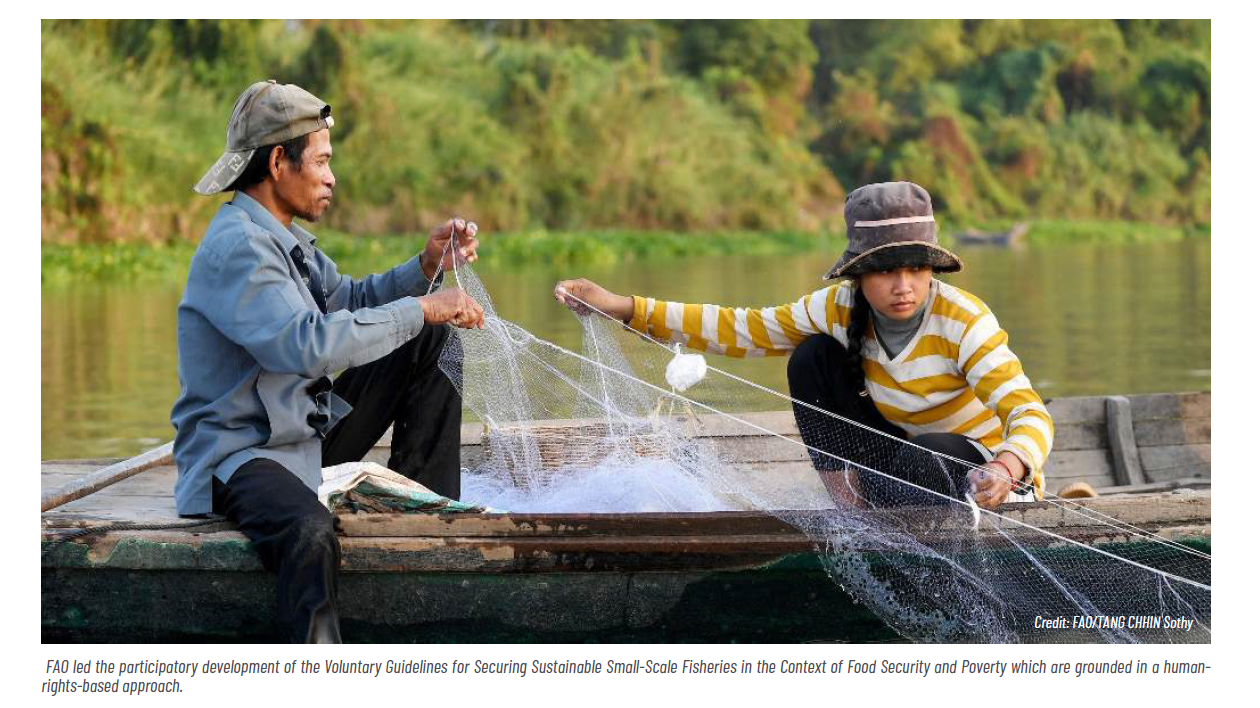
A: Small-scale fisheries play a foundational role in food security, livelihoods and cultural identity across Asia and the Pacific. It is therefore critical to ensure that small-scale fisheries (SSF) are effectively integrated into national strategies and regional cooperation frameworks.
Our workshop in March 2025 commemorated the 10-year anniversary of the SSF Guidelines and highlighted that, despite the vital socio-economic and environmental roles SSF play—contributing nearly half of capture fisheries production in Asia and supporting the livelihoods of millions—significant barriers still impede their full and meaningful inclusion in policy and management processes.
Many governments and stakeholders lack the technical and financial means to implement the SSF Guidelines effectively. There are also considerable data and knowledge gaps, with insufficient information on SSF contributions, needs and vulnerabilities. This in turn restricts evidence-based policymaking and equitable access to investment and social protection.
National policies often lack coherence or fail to clearly define SSF, making it difficult to design targeted interventions. Other issues include weak recognition of customary rights, which leaves SSF communities vulnerable to competing uses of aquatic and coastal space, as well as insufficient recognition of women’s essential contributions across SSF value chains.
Additionally, while SSF are on the frontline of climate impacts, access to early warning systems, safety-at-sea measures and adaptation support remains limited. Building on the findings of the
global study on small-scale fisheries, FAO will work with Members to develop specific National Plans of Action to support their small-scale fisheries (NPOA-SSF).
Addressing these gaps will require collaboration beyond fisheries institutions to include finance, social protection, market development, and stronger national and regional technical support. It will also require targeted research and reinforced political commitment, as seen in the National Plans of Action for small-scale fisheries (NPOA-SSFs) in the Philippines and Indonesia.
Q: Another major area of concern in the Asia-Pacific is illegal, unreported and unregulated (IUU) fishing. One of the most important initiatives developed by FAO in this regard has been the Port State Measures Agreement. At last count, 84 countries had become Parties to the Agreement, of which fewer than 30 are from the Asia-Pacific region. How does FAO work with regional governments to encourage them to become signatories if they have not already done so, and to support countries which are Parties in their national efforts to implement the PSMA?
A: FAO has worked closely with governments to strengthen action against IUU fishing, including promoting accession to, and implementation of, the Port State Measures Agreement (PSMA), and improving monitoring, control and surveillance (MCS). This has increasingly reduced opportunities for illegal, unreported and unregulated fishing and improved compliance in parts of the region. These efforts mean countries can better protect legal fishers, safeguard vulnerable stocks, and maintain access to high-value export markets.
Through its global PSMA programme and regional initiatives with partners such as
SEAFDEC and
BOBP-IGO, FAO provides technical guidance, capacity-building, and support for risk-based port controls and transshipment oversight. This includes legal assistance, training for inspectors, and strengthening institutional coordination.
In addition, FAO helps countries understand international trade implications, including World Trade Organisation (WTO) fishery subsidies, to ensure that national support policies contribute to sustainability and do not drive overfishing. Progress has also been seen in the wider adoption of food safety systems, which has helped improve market access, reduce trade disruptions and market rejections, and enhance consumer confidence.
There is a lot of work that remains to be done, but I am quite optimistic that the region is steadily improving the transparency, sustainability, and performance of its aquatic value chains.
Q: On 2 September 2025, FAO and the Secretariat of the Convention on Biological Diversity (CBD) announced the launch of a new global partnership to help countries monitor and report on ecosystem restoration, including in the Asia-Pacific. One of the aims was stated as to boost countries’ capacity for monitoring and reporting on Target 2 of the CBD’s Kunming-Montreal Global Biodiversity Framework, which commits countries to ensure that at least 30% of degraded terrestrial, inland water, coastal and marine ecosystems are under effective restoration by 2030. As at the time of this interview, it may be too early for FAO RAP to go into the details of any initiative or collaboration, but perhaps you could give readers a rough overview of what countries in the Asia-Pacific can expect in terms of possible areas of focus?
A: Yes, it is still early days, and we have yet to see how this programme will develop, but I expect it will complement FAO’s work on fisheries biodiversity and conservation.
Coastal and freshwater environments are some of the most vulnerable to human activities, and it is simple common sense that healthy habitats are essential for productive fisheries and aquaculture. Restoration objectives under Target 2 align well with efforts to rebuild fish stocks and the use of aquaculture to rehabilitate and restore degraded ecosystems. Our focus will be on improved methods of operations that not only prevent degradation, but which actively contribute to restoration.
We are already supporting countries on biodiversity conservation through ongoing initiatives related to Target 3, working with partners such as the International Union for Conservation of Nature (IUCN), Malaysia’s Department of Fisheries, the University of Queensland, and Indonesia’s Ministry of Marine Affairs and Fisheries (MMAF) under Global Environment Facility (GEF)-funded programmes. These efforts focus on improving the effectiveness of marine protected areas and other effective conservation measures (OECMs), and addressing freshwater biodiversity and conservation issues.
We are also developing, with The Nature Conservancy, regional case studies and advice on how aquaculture sites can contribute to biodiversity conservation at local and larger scales. This is an exciting new area for the region, which is home to some of the largest expanses of open-water aquaculture, where farms can support in-situ conservation of aquatic biodiversity.
Looking ahead, the focus will be on better integrating biodiversity goals with sustainable food production. This is particularly relevant with regard to the Global Biodiversity Framework’s Target 10 on sustainable fishery management and the improved footprint of capture fisheries through ecosystem approaches, and Target 5 on impacts on wild species. This requires a balanced framework and tools to assess impacts, cost-benefits, and trade-offs between food production and ecosystem integrity. We also need a better understanding of fishery management and stock assessments that accounts for multi-gear and multi-species interactions and the inevitable trade-offs from managing such complex fishery systems.
Q: And finally, on a personal note, what do you hope to achieve during your tenure as FAO Regional Representative for Asia and the Pacific?
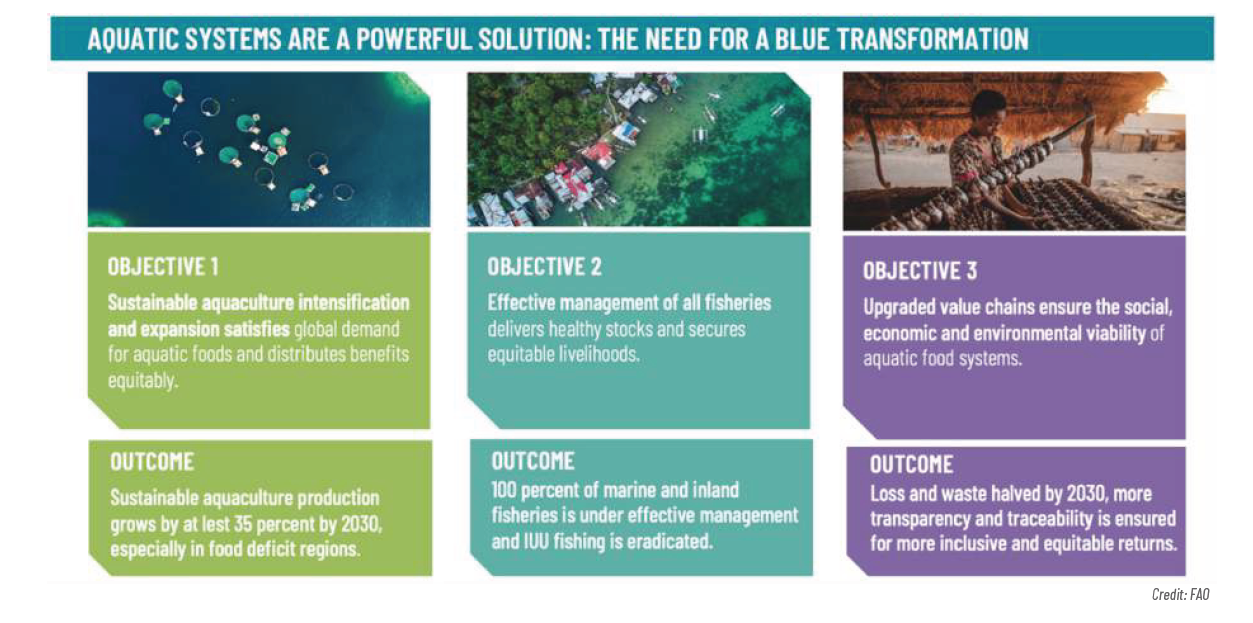
A: As you can imagine, I have responsibilities across the entire agriculture sector spanning crops, livestock, forestry, fisheries and aquaculture. Let me focus on what I hope to do with the fishery and aquaculture sectors. Coming from Indonesia, a country defined by its archipelagic nature and huge dependence upon its marine and freshwater resources, the challenges of Blue Transformation for our region are very close to my heart. So too is the knowledge that our region is home to the highest proportion of people dependent upon small-scale fisheries for their livelihoods and food security. The region is also home to the highest global levels of fish consumption, and fish play an iconic role in our diets and food culture.
My goal is to ensure a steady supply of safe, nutritious fish without compromising future resources. Up until now we have benefited from increasing productivity as we developed new technology and expanded the scale of aquaculture and capture fisheries. But we now realise that we are reaching the limits of supply from wild capture fisheries, and that aquaculture operations must improve their resource-use footprint if we want to continue enjoying fish on our plates. We also need to cut waste and improve efficiency across the value chain.
The good news is we have the means to do this, and increasingly there is political will and public support for the innovations and reforms that are needed. My role is to ensure that FAO is there to help countries rise to this challenge by providing the technical advice and capacity-building they need to transform their ideas into action.