FishBytes: Agreement on Marine Biological Diversity of Areas Beyond National Jurisdiction (BBNJ Agreement)
The Agreement under the United Nations Convention on the Law of the Sea on the Conservation and Sustainable Use of Marine Biological Diversity of Areas beyond National Jurisdiction (BBNJ Agreement) was adopted on 19 June 2023 by the Intergovernmental Conference on Marine Biodiversity of Areas Beyond National Jurisdiction convened under the auspices of the United Nations, and entered into force on 17 January 2026. The BBNJ Agreement becomes the third implementing agreement to the United Nations Convention on the Law of the Sea.
Under the overall objective of the conservation and sustainable use of marine biological diversity of areas beyond national jurisdiction, for the present and in the long-term, through effective implementation of the relevant provisions of the Convention and further international cooperation and coordination, the Agreement addresses four main issues:
Under the overall objective of the conservation and sustainable use of marine biological diversity of areas beyond national jurisdiction, for the present and in the long-term, through effective implementation of the relevant provisions of the Convention and further international cooperation and coordination, the Agreement addresses four main issues:
• Marine genetic resources, including the fair and equitable sharing of benefits;
• Measures such as area-based management tools, including marine protected areas;
• Environmental impact assessments; and
• Capacity-building and the transfer of marine technology.
Oceans beyond borders matter for people, planet and prosperity

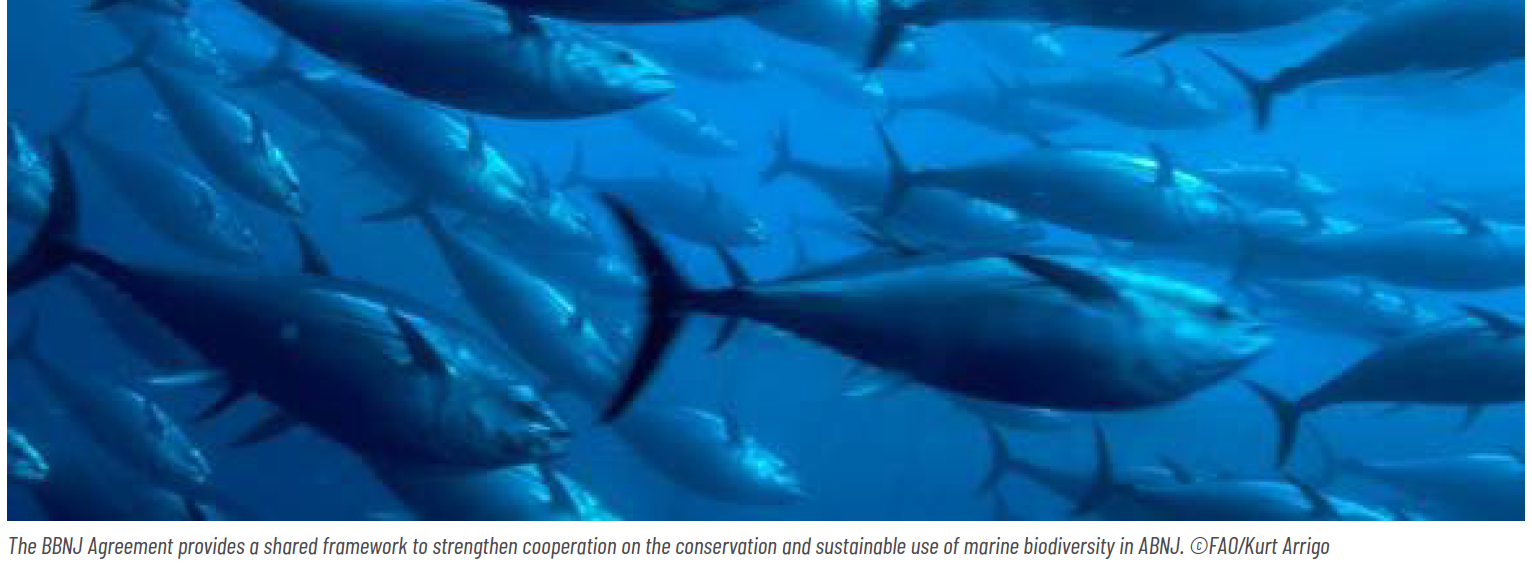
Before ending up on a dinner plate or sealed in a supermarket can, tuna spend much of their lives far from any coastline, moving through parts of the ocean that belong to no single country. These waters, known as Areas Beyond National Jurisdiction (ABNJ), are outside of any one country’s jurisdiction, extending from surface waters through the deep sea and down to the ocean floor. What happens there shapes marine ecosystems, economic development, livelihood opportunities and nutrition outcomes in countries thousands of kilometres apart.
ABNJ are often perceived as distant or abstract. In reality, they are among the most important parts of the ocean. They cover roughly two-thirds of its surface and include the vast majority of the total living space of the planet. Their water columns and seabed contain significant genetic and mineral resources that play a central role in sustaining global biodiversity.
ABNJ are often perceived as distant or abstract. In reality, they are among the most important parts of the ocean. They cover roughly two-thirds of its surface and include the vast majority of the total living space of the planet. Their water columns and seabed contain significant genetic and mineral resources that play a central role in sustaining global biodiversity.
Highly migratory species such as tuna, as well as many other known and even unknown species, depend on ABNJ for much of their life cycle. This links the health of these areas to national economies, development opportunities and diets in many regions. Furthermore, for many Small Island Developing States, ABNJ are not remote spaces. What happens in those waters affects their food security, employment and economic stability directly.
However, Areas Beyond National Jurisdiction are under growing pressure. Rising ocean temperatures are altering currents and species distributions. Pollution reaches even deep-sea environments. Unsustainable practices can weaken their capacity to respond to pressures, including fragile seabed habitats that recover slowly. When this happens, the impacts do not remain offshore. Fish stocks decline, ecosystems lose resilience, and coastal communities feel the consequences through reduced income, lost jobs and diminished access to nutritious aquatic foods.
Managing ABNJ is inherently complex. No single country has authority, yet many have activities and legitimate interests there. While rules for these areas have existed for decades, their implementation is spread across different sectors and bodies, often with limited coordination and effectiveness.
The Agreement on the Conservation and Sustainable Use of Marine Biodiversity of Areas Beyond National Jurisdiction (BBNJ Agreement) responds directly to this challenge. As an implementing agreement under the United Nations Convention on the Law of the Sea, it provides a shared framework to strengthen cooperation on the conservation and sustainable use of marine biodiversity in ABNJ. Its entry into force on 17 January marks a new chapter in ocean governance, introducing new management requirements and tools to cover regulatory gaps, and offering improved cooperation across existing sectors and bodies.
The BBNJ Agreement establishes rules for access to marine genetic resources and the fair sharing of benefits arising from their use. It creates a global framework to develop and coordinate area-based management tools and sets out obligations for environmental impact assessments of activities that may harm marine biodiversity. It also commits countries to capacity-building and the transfer of marine technology, particularly to support developing states.
The Agreement on the Conservation and Sustainable Use of Marine Biodiversity of Areas Beyond National Jurisdiction (BBNJ Agreement) responds directly to this challenge. As an implementing agreement under the United Nations Convention on the Law of the Sea, it provides a shared framework to strengthen cooperation on the conservation and sustainable use of marine biodiversity in ABNJ. Its entry into force on 17 January marks a new chapter in ocean governance, introducing new management requirements and tools to cover regulatory gaps, and offering improved cooperation across existing sectors and bodies.
The BBNJ Agreement establishes rules for access to marine genetic resources and the fair sharing of benefits arising from their use. It creates a global framework to develop and coordinate area-based management tools and sets out obligations for environmental impact assessments of activities that may harm marine biodiversity. It also commits countries to capacity-building and the transfer of marine technology, particularly to support developing states.
Fisheries and BBNJ
From 17 January, when the Agreement enters into force, the BBNJ framework becomes legally binding for its Parties. Yet, it cannot be treated as a system that starts from zero. Human activities, such as fishing, shipping, research, and bioprospecting, already take place throughout ABNJ. These uses are long established and governed through an existing global network of arrangements and bodies. The BBNJ Agreement does not replace these bodies, it is designed to work alongside them, filling gaps and improving coherence.
Fisheries sit at the centre of this relationship. As highlighted in the 1995 FAO Code of Conduct for Responsible Fisheries, fish are a core component of marine biodiversity, and their health depends on their ecosystems. When ecosystems are stressed, fish populations decline. At the same time, fisheries are fundamentally about people. Aquatic foods support livelihoods, incomes and nutrition for millions, meaning decisions taken in international waters have direct consequences for people and planet.
Over decades, countries have developed cooperative systems to manage fisheries in international waters through science-based rules and regional fisheries management organizations (RFMOs). These systems set catch limits, define spatial and temporal closures, and apply monitoring measures that ensure sustainable use of marine resources in ABNJ. Crucially, they have built practical experience directly relevant to implementing the BBNJ Agreement. Some of these systems have proven their effectiveness; almost 90 percent of the major tuna stocks are currently classified as sustainable exploited, reversing past depletions.
The BBNJ Agreement promises to connect conservation and sustainable use across the ocean, and the systems that regulate their uses. If implementation builds on existing governance and draws on sustainable practices already in place, the Agreement stands a far stronger chance of success, helping ensure healthy marine ecosystems offshore and secure agrifood systems for people on land.
Source:
Fisheries and Aquaculture Digest, 03 February 2026/Issue #81
Fisheries sit at the centre of this relationship. As highlighted in the 1995 FAO Code of Conduct for Responsible Fisheries, fish are a core component of marine biodiversity, and their health depends on their ecosystems. When ecosystems are stressed, fish populations decline. At the same time, fisheries are fundamentally about people. Aquatic foods support livelihoods, incomes and nutrition for millions, meaning decisions taken in international waters have direct consequences for people and planet.
Over decades, countries have developed cooperative systems to manage fisheries in international waters through science-based rules and regional fisheries management organizations (RFMOs). These systems set catch limits, define spatial and temporal closures, and apply monitoring measures that ensure sustainable use of marine resources in ABNJ. Crucially, they have built practical experience directly relevant to implementing the BBNJ Agreement. Some of these systems have proven their effectiveness; almost 90 percent of the major tuna stocks are currently classified as sustainable exploited, reversing past depletions.
The BBNJ Agreement promises to connect conservation and sustainable use across the ocean, and the systems that regulate their uses. If implementation builds on existing governance and draws on sustainable practices already in place, the Agreement stands a far stronger chance of success, helping ensure healthy marine ecosystems offshore and secure agrifood systems for people on land.
Source:
Fisheries and Aquaculture Digest, 03 February 2026/Issue #81
ADVERTISEMENTS