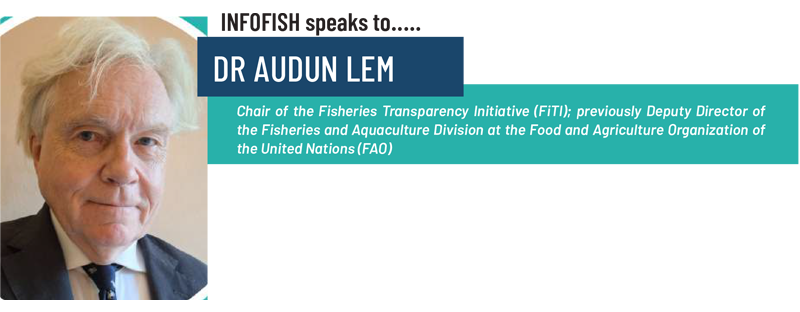
Q: Congratulations on being appointed the new Chair of The Fisheries Transparency Initiative (FiTI). As a member of FAO’s network of global advisory services, INFOFISH knows you well from your over 25 years at the Organization, and from which you retired recently after having held the position of Deputy Director of the Fisheries and Aquaculture Division for more than ten years.
FiTI is stated as being a global partnership that increases transparency and participation for a more sustainable management of marine fisheries. Could you provide some background on the organisation for the benefit of readers?
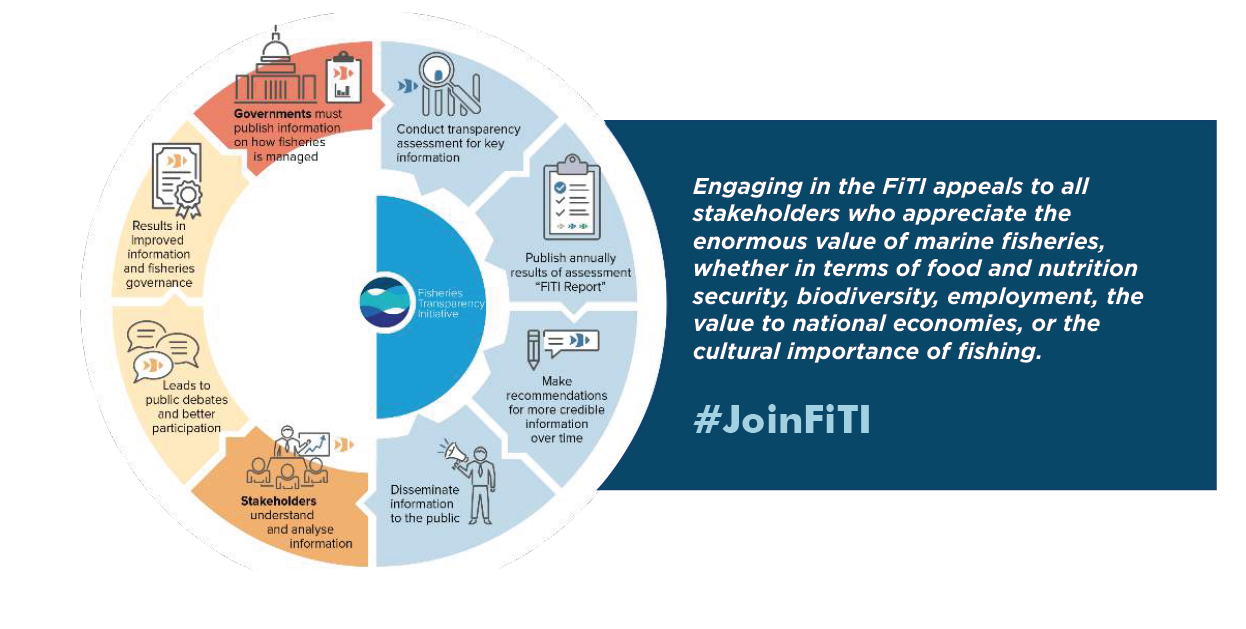
A: Access to reliable data is key for making informed decisions in any sector and FiTI is certainly inspired by transparency initiatives in other extractive industries. The fisheries sector has of course several characteristics that set us apart; for example, the fact that fisheries resources are renewable, that they often are shared, that stocks migrate across borders and that a lot of fishing takes place on the high seas. In addition, fishing is particularly important for many developing countries that rely on fisheries both for livelihoods and export revenues. Last year we celebrated our 10-year anniversary and we now have 13 countries that are part of FiTI and actively implementing the FiTI Standard1 for more transparency and sustainable fisheries.
Q: Why was it considered necessary for FiTI to be set up, and what makes the organisation unique?
A: The rationale for creating FiTI back in 2015 builds on experience from other sectors which shows that improving access to data leads to better decisions. In addition, increasing stakeholder representation enables more effective implementation of government policy. There are of course many organisations and institutions that work towards more sustainable marine fisheries but FiTI is the only one focusing on transparency as such, and improved access to data and information for better management. In addition, we are a multi-stakeholder organisation with equal representation from our three stakeholder groups: governments, the business sector with equal participation from small-scale and industrial fisheries, and civil society. Meanwhile, the FiTI Standard sets clear requirements for what a government has to divulge in terms of data and the need to create an enabling environment with broad participation from the sector. We are also fortunate to have observers from both the World Bank, FAO and the Open Government Partnership on our board.
Q: Promoting transparency to achieve more sustainable management of marine fisheries requires the compilation of detailed, timely, and accurate information from countries. But as INFOFISH also knows, some countries may be hesitant or reluctant to share data on fisheries harvests. It could be that this simply is not a priority or, for example, that there is not a shared understanding of terms such as subsidies which may be labelled in national programmes as “assistance”. How does FiTI help countries to manage and present information while ensuring transparency?
A: The lack of information about fisheries does not necessarily stem from a lack of stakeholder demand or regulatory requirements. Many of the elements included in demands for transparency in the fisheries sector are already established in international agreements or policy papers on fisheries reforms, such as FAO’s landmark Code of Conduct on Responsible Fisheries or its Voluntary Guidelines for Securing Sustainable Small-Scale Fisheries.
For example, countries are already required to share their catch data with other organisations such as FAO for statistical purposes and also when reporting on progress towards the targets under SDG14. In addition, the new WTO Agreement requires reporting of stock status in order to use any kind of subsidies for the targeted species; and for reporting on the support given to the sector. So, this requirement in the FiTI Standard is not something that countries have to be afraid of; we are not asking for breakdowns per vessel but aggregate data per species, vessel category and gear. It is more worrying if the government doesn’t have the data (which unfortunately is sometimes the case) due to lack of resources or institutional capacity. But being transparent about this is also the first step towards improving the situation.
Q: Specific to illegal fishing, how does using the FiTI Standard help in reducing its scale? How does the Standard complement other global legal frameworks related to IUU fishing?
A: There is no silver bullet in the fight against IUU fishing but the toolbox available to policymakers is steadily becoming better equipped. With the PSMA Agreement, the Global Record, catch documentation schemes, and the WTO Agreement complemented by market-based instruments, we have entered a new era in which civil society and consumers as well as importers, processors and distributors have come to expect that the fish that reach consumers have been caught sustainably and legally. But all these instruments only become effective through a data-driven and stakeholder-inclusive approach. This is where FiTI provides the foundation, by requesting, for example, national authorities to publish information on their legal framework, vessel registries, access agreements or catch data, to name just a few.
Q: Recently, FiTI announced the launch of a new web-based tool called Fisheries Information System (FIS), stating that it would be of “particular interest for low- and lower-middle income countries and Small Island Developing States (SIDS), which often lack financial, human and technical resources to provide information to the general public online”. Is it correct to say that the FIS is a simpler version of the FiTI Standard? What are some key distinctions or advantages, and to date, how many countries have committed to using the FIS?
A: The FiTI Standard emphasises the need for national authorities to develop and strengthen their own systems for collecting and publishing information online in a complete, accessible and understandable manner. The FIS facilitates this by providing a web-based tool for organising information and for public reporting.
So, it is not really a “lighter” or simpler version. It is a new and groundbreaking tool for interested FiTI countries, through which they can make fisheries data publicly accessible. The data reported through the FIS belongs to the government, is inserted by them, remains under the control of the government, but is shared publicly.
The FIS is brand new and we are excited by its potential. It is currently being rolled out in two FiTI countries (i.e. São Tomé and Príncipe, and Cabo Verde) and we are already preparing the roll-out of the FIS to Madagascar and Ghana, with other FiTI countries already expressing interest. However, FiTI countries do not need to use the FIS to achieve compliance with the FiTI Standard. It is a voluntary offering to our member countries.
Q: But since participation is voluntary, why would countries allocate resources in order to implement the FiTI Standard and FIS? In other words, how do countries and their coastal fisheries sector benefit?
A: The ultimate objective of FiTI is, through improved transparency, to increase country benefits from their aquatic resources, improve fisheries management and stakeholder engagement.
Much of the information required by the FiTI Standard already exists within the public sector but it remains spread among various ministries and is frequently not accessible to the public. Improving access to data also makes the sector more transparent, thereby reducing risks and uncertainty for investors and financial institutions.
Therefore, it is not really a question of allocating resources, but rather of making a public commitment to improve transparency and access to data in the sector by joining FiTI. The FIS facilitates this by providing a dedicated web-based tool.
Q: On a final note, if you recall, we had two prior interviews with you while you were at FAO, the most recent being in June 2025 shortly before your retirement. You had said that as someone who has been providing technical input in the development of the WTO Agreement on Fisheries Subsidies for more than 25 years, you looked forward to continuing to support the implementation of the agreement. Will this be one of your key priorities as the Chair of FiTI during your three-year term, and how do you see FiTI’s role evolve in this regard?
A: Certainly, promoting transparency on fisheries issues also includes openness about public financial support to the sector and about subsidy payments.
In fact, transparency on subsidy payments is a key requirement under the WTO Agreement on Fisheries Subsidies, and with this in mind, the new FiTI Standard as well as the FIS are aligned with the reporting obligations of the WTO Agreement. The WTO itself recognises how useful this is as a reporting mechanism; it has already approved several country requests for financial support from the WTO Fish Fund with regard to implementing the parts of the Agreement that make specific reference to FiTI and the FIS.
One should not forget though, that negotiations on other issues mandated under the WTO Agreement such as subsidies causing overcapacity and overfishing remain to be settled. In this context, FiTI’s role in improving transparency and access to data on vessel registries, licences, access agreements, stock status and others remains as important and relevant as ever.
Notes:
1) https://fiti.global/fiti-standard
2) https://pdflink.to/7142d442/