Article II 5/2025 - TURNING INVASIVE FISH INTO A GOLDEN OPPORTUNITY
By Gregg Yan and Jonah van Beijnen
A range of non-native fish species, including Midas cichlids, are now firmly established in the Philippines, but some enterprising farmers are beginning to capitalise on these invaders.
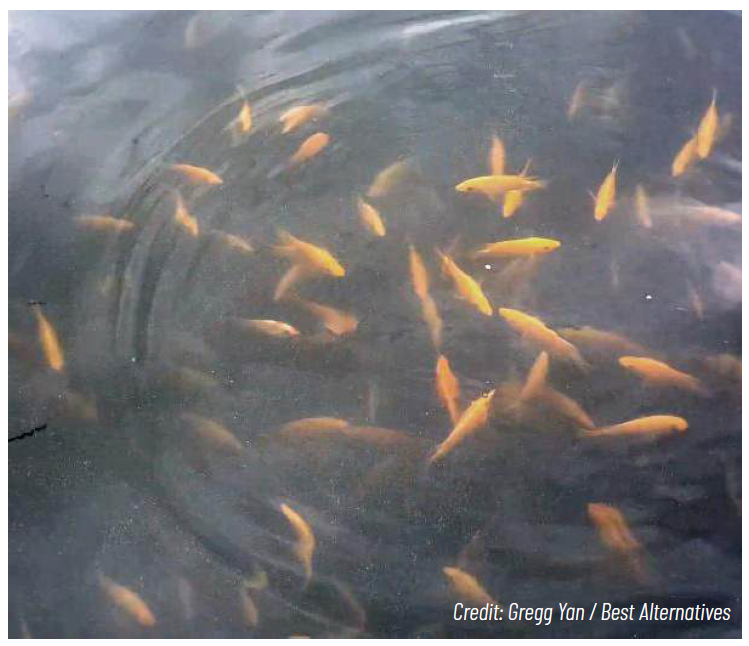
Locally known as “flowerhorns”, these Midas cichlids escaped from aquarium breeders in 2015 and are now growing wild in Lake Sampaloc, a 104-hectare lake two hours south of Metro Manila in the Philippines. See the fish live in this VIDEO.
If you gaze hard enough at the olive waters of Lake Sampaloc in the Philippines, you’ll notice darting specks of gold. They’re cichlids from South America, escapees from the aquarium trade and – for good or for naught – now part of the lake’s ecosystem.
Today, many tropical waterways teem with invasive tilapia, carp, guppies and snakeheads, while cooler waters abound with introduced trout, bass and salmon. A new study found that 601 non-native fish species have colonised 55 percent of the planet’s freshwater bodies (Xu et al., 2024).
The Philippines, known more for its vibrant coral reefs than its rivers and lakes, has long had a problem with the release of unwanted exotic pets, government programmes that release exotic fingerlings in public waters, plus escapees from the aquaculture sector, some overpowering enough native life to be considered invasive.
The most recent census of Philippine freshwater fish recorded 374 species. Of these, 225 are native (naturally occurring), 85 are endemic (naturally found in a limited region within the country) and at least 64 are non-native (introduced from other regions) (Jamandre, 2023). An earlier study recorded 170 foreign fish species introduced into the Philippines in the past century (Cagauan in 2008) – ranging from armoured catfish from the Amazon Basin to ravenous knifefish from Indochina.
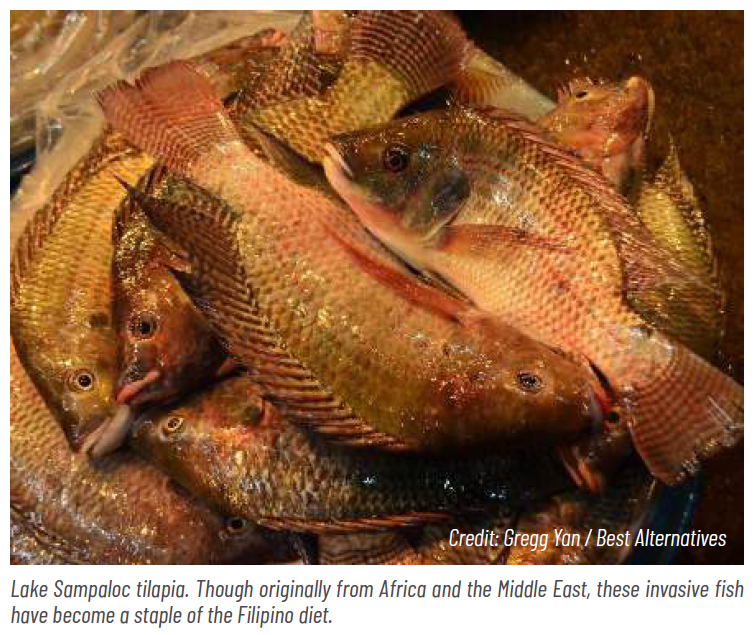
To be fair, some of these invaders – like tilapia and catfish – have over time become staple commodities, feeding millions of Filipinos and employing thousands in the local aquaculture sector.
If you gaze hard enough at the olive waters of Lake Sampaloc in the Philippines, you’ll notice darting specks of gold. They’re cichlids from South America, escapees from the aquarium trade and – for good or for naught – now part of the lake’s ecosystem.
Today, many tropical waterways teem with invasive tilapia, carp, guppies and snakeheads, while cooler waters abound with introduced trout, bass and salmon. A new study found that 601 non-native fish species have colonised 55 percent of the planet’s freshwater bodies (Xu et al., 2024).
The Philippines, known more for its vibrant coral reefs than its rivers and lakes, has long had a problem with the release of unwanted exotic pets, government programmes that release exotic fingerlings in public waters, plus escapees from the aquaculture sector, some overpowering enough native life to be considered invasive.
The most recent census of Philippine freshwater fish recorded 374 species. Of these, 225 are native (naturally occurring), 85 are endemic (naturally found in a limited region within the country) and at least 64 are non-native (introduced from other regions) (Jamandre, 2023). An earlier study recorded 170 foreign fish species introduced into the Philippines in the past century (Cagauan in 2008) – ranging from armoured catfish from the Amazon Basin to ravenous knifefish from Indochina.
To be fair, some of these invaders – like tilapia and catfish – have over time become staple commodities, feeding millions of Filipinos and employing thousands in the local aquaculture sector.
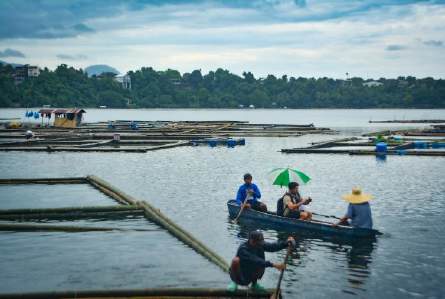
Farmers in Lake Sampaloc or ‘Tamarind Lake’ mostly grow tilapia in 600 or so floating bamboo fish pens, supplying provinces such as Laguna and Batangas with fresh and affordable seafood. Watch more in this VIDEO.
Lake Sampaloc possibly hosts the most country’s most colourful freshwater invasive. It brims with golden cichlids, which have been identified as Midas cichlids (Amphilophus citrinellus). Midas cichlids are sought-after in the aquarium trade due to their bright and highly variable colouration, ranging from bright orange to jet-black. Highly aggressive, the cichlids grow to about a foot in length and develop an impressive nuchal hump, a ball-like organ on their foreheads. Midas cichlids are also used to create hybrid “flowerhorns” which are immensely popular with Asian aquarists.
“We call these golden fish flowerhorns and they were introduced here some time in 2015,” explains Jepolo Austria, a local fish farmer in Lake Sampaloc. “They escaped when a powerful storm hit our province and damaged a local aquarium fish breeder’s facility. Ten years later, they have spread to all parts of our lake. Look anywhere and you’ll see a bit of gold.”
“We call these golden fish flowerhorns and they were introduced here some time in 2015,” explains Jepolo Austria, a local fish farmer in Lake Sampaloc. “They escaped when a powerful storm hit our province and damaged a local aquarium fish breeder’s facility. Ten years later, they have spread to all parts of our lake. Look anywhere and you’ll see a bit of gold.”
Integrating invasives into aquaculture operations
Though scientists have yet to gauge the long-term effects of the Midas cichlids in Sampaloc Lake, a 2016 study by Briones et al. found that nine of the 12 remaining fish species inhabiting the lake were invasive. The most economically important are hybrid Nile tilapia (Oreochromis niloticus), cultured in the lake’s 600-odd bamboo cages, where they are farmed for four to five months before being harvested at around 300 grams. When harvested, these tilapias sell for around USD 1.40 per kilogram wholesale and around USD 1.70 retail, a price at which it is hard to turn a good profit, considering that feeds can cost farmers nearly USD 1 per kilogram.
Some fish farmers have passively started to catch and sell wild Midas cichlids when they visit their floating bamboo farms, using everything from nets and poles to pneumatic spear guns. As the fish now multiply naturally in the lake, farmers have spotted a golden opportunity to supplement their earnings.
“To encourage fisherfolk to catch the cichlids, I tapped a local cooperative to supply them,” explains entrepreneur EJ Delgado. “We purchase the Midas cichlids for USD 0.30 to USD 1 per kilogram. We then fillet and sometimes de-bone them, soak the fillets in a brine solution for 20 minutes, then sun-dry them.”
EJ says consumer reception has been positive, with the dried golden cichlids – known as “golden krispies” – retailing for around USD 5 per kilogram – much better than the local prices for farmed tilapia.
Jepolo on the other hand, catches and sells the most colourful cichlids live. “I sell them for USD 1.70 per kilogram or USD 0.2 apiece live. They are perfect for ponds because they look a bit like koi. They are quite colourful to look at from above,” he explains.
Aside from catching them, Jepolo’s only input is to sporadically feed the fish with pellets and packing them in aerated bags whenever buyers contact him – a great idea for a novel aquaculture venture.
“Catching and selling these invasives might be a good option to rid Lake Sampaloc of these Midas cichlids, which have also started colonising Taal Lake, about 35 kilometers away. The Philippine government through the Bureau of Fisheries and Aquatic Resources (BFAR) is already addressing the proliferation of knifefish and janitor fish,” explains Dr. Maria Rowena Eguia, an associate professor at the De La Salle University Manila, who formerly worked with the Southeast Asian Fisheries Development Center (SEAFDEC), an intergovernmental agency that helps develop fisheries in the region. The Philippine government has an existing fish conservation and management programme called Balik Sigla sa Ilog at Lawa (BASIL), where introduced fish are monitored and assessed for invasiveness.
“BFAR implemented a programme where they buy caught knifefish or janitor fish, process them further as value-added food or use the meat as a source of animal protein in fish feeds,” Dr Eguia adds.
Some fish farmers have passively started to catch and sell wild Midas cichlids when they visit their floating bamboo farms, using everything from nets and poles to pneumatic spear guns. As the fish now multiply naturally in the lake, farmers have spotted a golden opportunity to supplement their earnings.
“To encourage fisherfolk to catch the cichlids, I tapped a local cooperative to supply them,” explains entrepreneur EJ Delgado. “We purchase the Midas cichlids for USD 0.30 to USD 1 per kilogram. We then fillet and sometimes de-bone them, soak the fillets in a brine solution for 20 minutes, then sun-dry them.”
EJ says consumer reception has been positive, with the dried golden cichlids – known as “golden krispies” – retailing for around USD 5 per kilogram – much better than the local prices for farmed tilapia.
Jepolo on the other hand, catches and sells the most colourful cichlids live. “I sell them for USD 1.70 per kilogram or USD 0.2 apiece live. They are perfect for ponds because they look a bit like koi. They are quite colourful to look at from above,” he explains.
Aside from catching them, Jepolo’s only input is to sporadically feed the fish with pellets and packing them in aerated bags whenever buyers contact him – a great idea for a novel aquaculture venture.
“Catching and selling these invasives might be a good option to rid Lake Sampaloc of these Midas cichlids, which have also started colonising Taal Lake, about 35 kilometers away. The Philippine government through the Bureau of Fisheries and Aquatic Resources (BFAR) is already addressing the proliferation of knifefish and janitor fish,” explains Dr. Maria Rowena Eguia, an associate professor at the De La Salle University Manila, who formerly worked with the Southeast Asian Fisheries Development Center (SEAFDEC), an intergovernmental agency that helps develop fisheries in the region. The Philippine government has an existing fish conservation and management programme called Balik Sigla sa Ilog at Lawa (BASIL), where introduced fish are monitored and assessed for invasiveness.
“BFAR implemented a programme where they buy caught knifefish or janitor fish, process them further as value-added food or use the meat as a source of animal protein in fish feeds,” Dr Eguia adds.
Eating invasives to extinction?
A possible solution to rid Lake Sampaloc of the golden Midas cichlids is to eat them to extinction. Red tilapia, also known as “kingfish” for instance, is just a red morph of the Nile tilapia and sells for up to double the price of normal-coloured tilapia despite tasting the same. It’s no stretch to creatively market Midas cichlids to the right consumers.
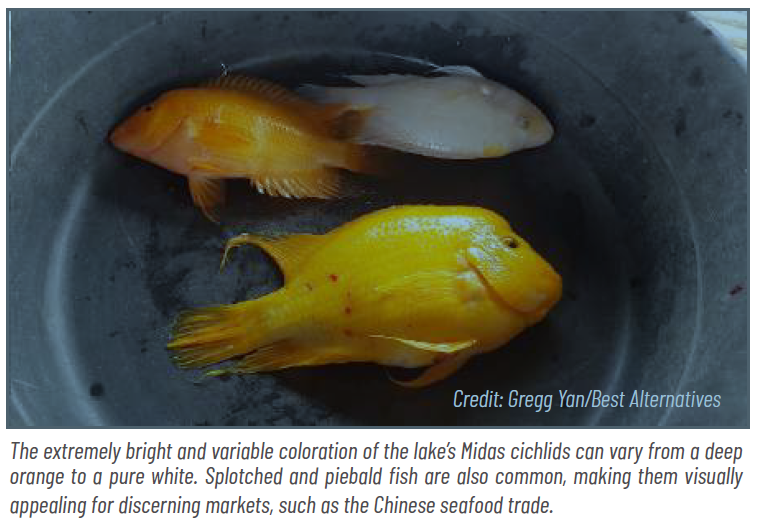
The Chinese seafood market, for example, loves red or golden-hued fish as it signifies luck and prosperity. Tonnes of red grouper and snapper are caught and sold for top dollar, so Midas cichlids might actually be a sustainable alternative. We even tried a platter of fried Midas cichlids, ourselves. The taste? Like buttery tilapia.
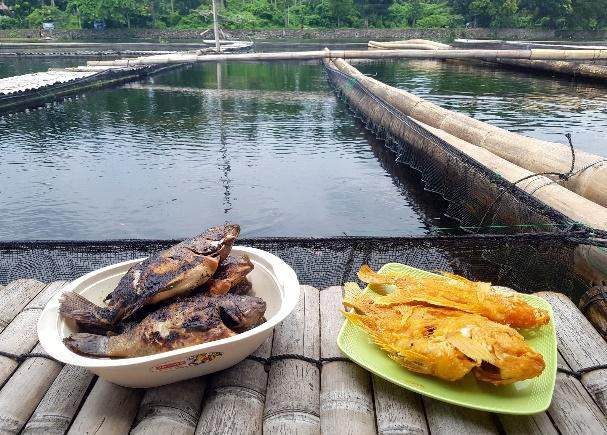
The Fish Site compared the Midas cichlids with regular tilapia and found the meat juicier, tastier and buttery. It passes the taste test with – you guessed it – a gold medal. Watch the fishy feast HERE.
The deliberate overfishing of invasive fish has already been tried in other regions. In Bolivia, the invasive paiche (Arapaima gigas), Earth’s largest scaly freshwater fish and a popular, plus-sized pond pet – is being marketed as a sustainable freshwater seafood option.
The "eat lionfish" campaign in the United States was similarly launched to curb growing numbers of invasive fish – this time in Atlantic Ocean reefs.
A small-scale campaign along the same lines might rid Sampaloc Lake of its Midas cichlids, being careful to ensure that no additional demand is created, prompting enterprising fish farmers to culture them in new waterways.
The deliberate overfishing of invasive fish has already been tried in other regions. In Bolivia, the invasive paiche (Arapaima gigas), Earth’s largest scaly freshwater fish and a popular, plus-sized pond pet – is being marketed as a sustainable freshwater seafood option.
The "eat lionfish" campaign in the United States was similarly launched to curb growing numbers of invasive fish – this time in Atlantic Ocean reefs.
A small-scale campaign along the same lines might rid Sampaloc Lake of its Midas cichlids, being careful to ensure that no additional demand is created, prompting enterprising fish farmers to culture them in new waterways.
Enhancing the value of native species
Ecologically, native fish are better suited to the local climate and better adjusted to local disease. Economically, they are often far more valuable than invasive fish.
Lake Sampaloc has just three types of native fish left, the most important of which is a small silver fish called the ayungin (Leiopotherapon plumbeus), a tasty silvery-green fish. Once common in large lakes, ayungin have since been eaten to the margins – both by people and invasive fish.
Lake Sampaloc has just three types of native fish left, the most important of which is a small silver fish called the ayungin (Leiopotherapon plumbeus), a tasty silvery-green fish. Once common in large lakes, ayungin have since been eaten to the margins – both by people and invasive fish.
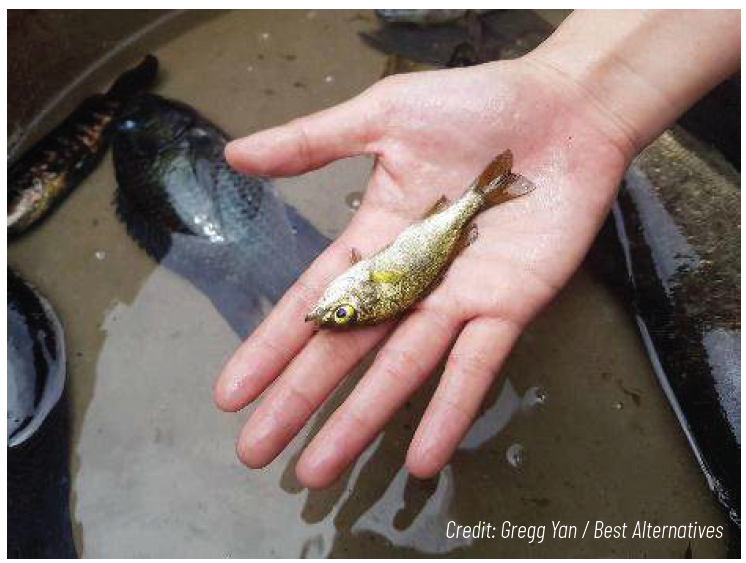
Around 10 kilograms of ayungin or silver perch (Leiopotherapon plumbeus) are harvested by a handful of net fishers in Lake Sampaloc daily. The small, silvery-green fish used to be abundant, but have been pushed to the sidelines by invasive fish like tilapia, carp and golden cichlids. Government interventions are underway to help conserve remaining stocks.
“Ayungin or silver perch is a small freshwater fish considered endemic to Laguna Lake before being translocated to other inland water bodies in the Philippines,” explains Romualdo Pol of the BFAR’s National Inland Fisheries Training Center. “Ayungin is important to the country’s culture and ecology. Many consider it the tastiest of all freshwater fish and its market price reflects this. It retails from USD 7 to USD 14 per kilogram.”
Public and private sector initiatives are now underway to ascertain the aquaculture potential of ayungin. After first exploring the aquaculture potential of the species, SEAFDEC then developed a hatchery protocol for ayungin, which is now readily available to interested farmers.
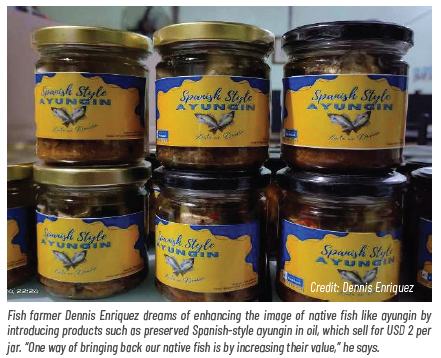
Though the world might see commercial-scale ayungin farms in the future, most of the fish are still sourced wild. Fishers in Lake Sampaloc still pull out a combined total of around 10 kilograms of the silver fish daily. “One way of protecting our native fish is by increasing their value,” says local farmer Dennis Enriquez, who is developing new products to help market the once-popular native fish. “I’m now working on a line of Spanish-style ayungin bottles, which retail for around USD 2.” The preserved fish offer something different from preserved tuna or milkfish and Enriquez hopes they could become a future seafood commodity in the Philippines.
“Ayungin or silver perch is a small freshwater fish considered endemic to Laguna Lake before being translocated to other inland water bodies in the Philippines,” explains Romualdo Pol of the BFAR’s National Inland Fisheries Training Center. “Ayungin is important to the country’s culture and ecology. Many consider it the tastiest of all freshwater fish and its market price reflects this. It retails from USD 7 to USD 14 per kilogram.”
Public and private sector initiatives are now underway to ascertain the aquaculture potential of ayungin. After first exploring the aquaculture potential of the species, SEAFDEC then developed a hatchery protocol for ayungin, which is now readily available to interested farmers.
Though the world might see commercial-scale ayungin farms in the future, most of the fish are still sourced wild. Fishers in Lake Sampaloc still pull out a combined total of around 10 kilograms of the silver fish daily. “One way of protecting our native fish is by increasing their value,” says local farmer Dennis Enriquez, who is developing new products to help market the once-popular native fish. “I’m now working on a line of Spanish-style ayungin bottles, which retail for around USD 2.” The preserved fish offer something different from preserved tuna or milkfish and Enriquez hopes they could become a future seafood commodity in the Philippines.
Once enterprising farmers eradicate invasive fish by selling all they catch as food or ornamental fish, then native fish might again repopulate waterways. Embracing native fish species makes economic and environmental sense and the example of Brazil has proven that, with the right marketing, natives can beat invaders.
People profiting from valuable commodities aren’t likely to let them go extinct, so creatively marketing them while curbing invasive species offers native fish a chance to swim for as long as people need to eat. This can be a win-win situation for everyone, especially for the native species.
People profiting from valuable commodities aren’t likely to let them go extinct, so creatively marketing them while curbing invasive species offers native fish a chance to swim for as long as people need to eat. This can be a win-win situation for everyone, especially for the native species.
ADVERTISEMENTS