Article II 2/2026 - EMPOWERING WOMEN THROUGH INNOVATIVE DRY FISH PROCESSING TECHNOLOGIES IN CAMBODIA
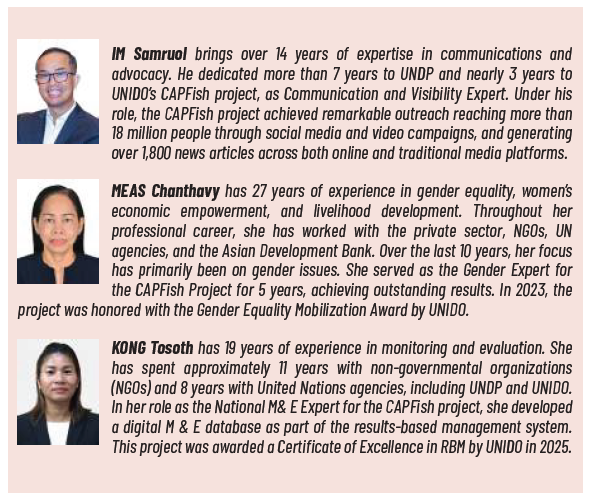
By IM Samruol, MEAS Chanthavy and KONG Tosoth
The article highlights practical experiences and outcomes from the CAPFISH-Capture: Post-harvest Fisheries Development project in Cambodia, focusing on how improved dry fish processing technologies have contributed to women’s economic empowerment, enhanced product quality, and strengthened market access in the post-harvest fisheries sector. It offers policy-relevant insights and field-based lessons that may be of interest to readers, particularly those engaged in fisheries development, value-addition, and inclusive growth in the region.
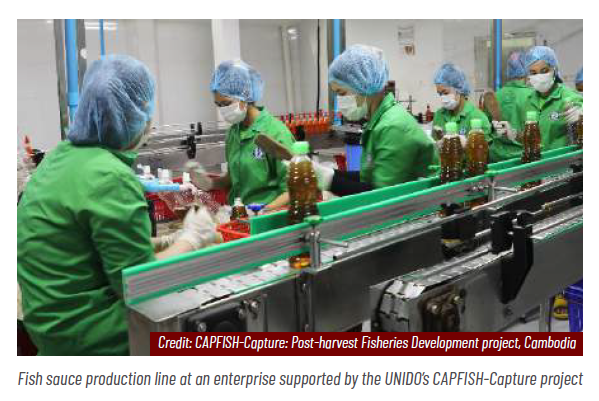
Fisheries are a cornerstone of Cambodia’s socio-economic development. They provide employment opportunities, generate income, and contribute significantly to food security and nutrition in rural communities, while boosting national GDP.
Women are central to this sector, making up around 70% of the post-harvest workforce. They clean, process, package, and market dried fish products, ensuring that fish and fishery products reach consumers across the country.
Yet, despite their essential contributions, women remain at the bottom of the value chain. Many fish processing enterprises are micro- or small-scale, often informal, and women face persistent gender inequalities that limit their opportunities for advancement. Their work is vital, but their voices are often unheard.
The challenge: Traditional practices and barriers
Most women-led enterprises rely on traditional methods such as open sun-drying. These practices are labour-intensive, weather-dependent, and prone to contamination and post-harvest losses. Productivity is low, quality is inconsistent, and market access is limited.
Beyond technical barriers, women face structural challenges. Unpaid care responsibilities restrict mobility and access to resources, while gender inequalities limit opportunities for training and leadership. The 2021 Gender Analysis Study highlighted these gaps and recommended strategies to promote gender equality and empowerment.
This study revealed that women’s contributions were undervalued, despite their majority presence in the sector. It emphasized the need for tailored interventions to improve skills, access to technology, and leadership opportunities, ensuring that women can participate fully in decision-making and value creation in Cambodia’s fisheries sector interventions to address gender disparities, improve working conditions, and create pathways for women to move up the value chain.
Introducing CAPFISH-Capture
The CAPFISH-Capture: Post-harvest Fisheries Development project, co-funded by the European Union (EU) and implemented by the United Nations Industrial Development Organization (UNIDO) in collaboration with Cambodia’s Fisheries Administration (FiA), private sector stakeholders, universities, and support institutions (2019–2025), aims to enhance the competitiveness of post-harvest fisheries operators and foster sustainable, inclusive growth.
The project envisions a sector where both women and men equally lead, participate in, and benefit from inclusive and sustainable industrial development. Its goal is to improve regulatory systems, promote better practices, and enhance market access, ensuring that women make up at least 40% of beneficiaries at all levels. CAPFish embedded gender equality and women’s economic empowerment into its value-chain development approach, ensuring that sector competitiveness is aligned with inclusive and sustainable growth.
The project envisions a sector where both women and men equally lead, participate in, and benefit from inclusive and sustainable industrial development. Its goal is to improve regulatory systems, promote better practices, and enhance market access, ensuring that women make up at least 40% of beneficiaries at all levels. CAPFish embedded gender equality and women’s economic empowerment into its value-chain development approach, ensuring that sector competitiveness is aligned with inclusive and sustainable growth.
Innovative technologies: A game-changer
UNIDO introduced innovative dry fish processing technologies and green solutions such as solar dryer domes, chillers, refrigerators, and vacuum machines. These reduce contamination, improve hygiene, alleviate physical strain, and minimize post-harvest losses.
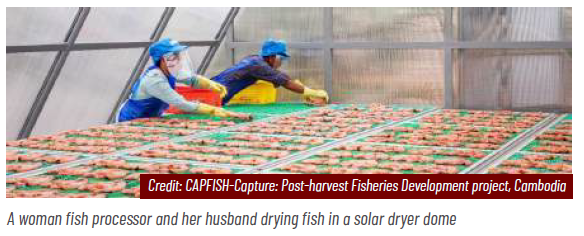
By modernizing facilities and introducing simple yet effective tools, 73% women-led enterprises are now better-positioned to meet food safety standards, increase productivity, and access new markets. The adoption of solar dryer domes, for example, has transformed the way fish is processed. Unlike open sun-drying, which is vulnerable to weather and contamination, solar dryers provide controlled conditions that ensure consistent quality and safety.
Empowering women: Skills, voices, and leadership
Capacity-building programmes were central to the project. A pool of Business Development Service (BDS) providers was developed, with 45% of them being women, and training was provided to the women entrepreneurs on food safety, business planning, record-keeping, labeling, and marketing. These interventions not only enhanced technical skills but also built confidence and leadership capacity.
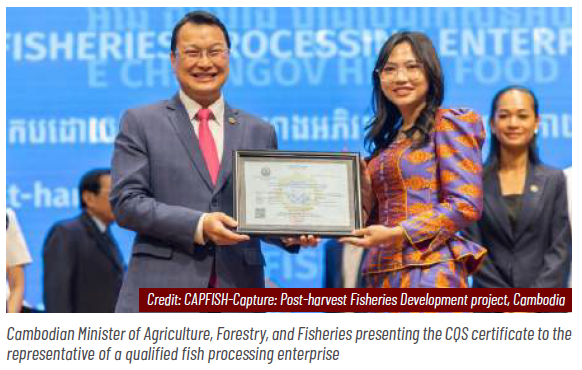
Importantly, Gender Equality and Women’s Empowerment (GEWE) were integrated into policies, including the Cambodia Quality Seal (CQS) food safety certification. Impressively, 68% of the enterprises certified under CQS are women-led, and 64% of these women-led enterprises are implementing a traceability system in their operations. This achievement demonstrates that women are not only participants but leaders in ensuring food safety and quality standards.
The project also supported women in accessing resources and networks. By linking them to cooperatives, markets, and support institutions, women gained visibility and recognition as entrepreneurs.
Community impact: Beyond individual gains
The project’s ripple effects extend to households and communities. Women-led enterprises under the Value Chain Investment Support (VCIS) schemes have received USD 1.86 million in direct support. The grants are often blended with collateral-free loans from financial institutions under the framework of an Investment Support Facility (ISF). This funding has leveraged USD 4.18 million in additional investments from the enterprises themselves and others, strengthening resilience, upgrading business operations, and creating role models for inclusive growth.
Marketing support, such as logos, labels, and promotional materials, helped 72% of women-led enterprises expand visibility and sales. Collectively, these efforts have improved household incomes, strengthened cooperatives, and enhanced food security.
The impact is not only economic but also social. Women who once struggled with informal, low-income activities now stand as respected business leaders. Their success inspires younger generations and challenges traditional norms about gender roles in fisheries.
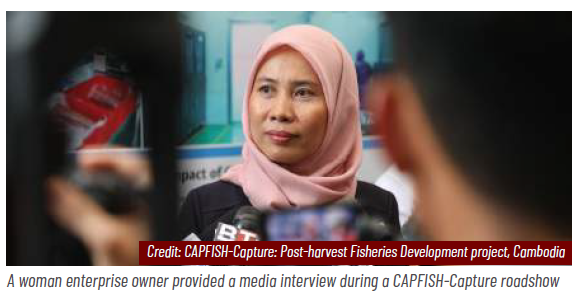
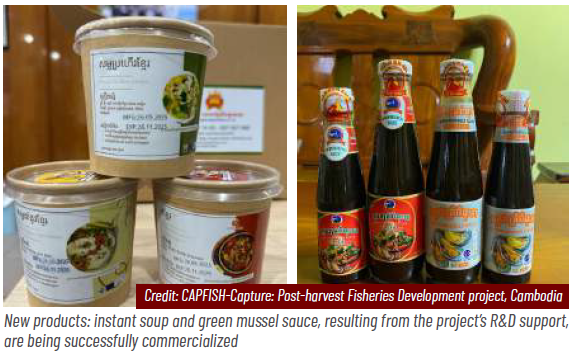
Beyond enterprise support, women researchers have played a pivotal role in research and development. Out of 33 supported research projects, 13 are led by women, and women comprise more than half of the core research teams (36 out of 68 members). Their leadership has already resulted in seven women-led enterprises accessing critical services for product development and the successful commercialization of nine products. These achievements highlight women’s growing influence not only in processing, but also in innovation and scientific advancement.
Market access and sustainability
Women-owned enterprises now access both local and international markets. Twelve enterprises participate in “One Village One Product” initiatives and weekend markets in Phnom Penh and Siem Reap, while two have successfully exported fish products to New Zealand and Australia.
Sustainability is embedded in the project’s design: eco-friendly technologies reduce waste, while regulatory frameworks integrate gender-responsive safeguards. By promoting green technologies and embedding gender considerations into food safety systems, the project ensures that progress is both inclusive and sustainable.
Voices from the field
Behind the statistics are transformative human stories which illustrate empowerment not only in economic terms but also in dignity, recognition, and leadership. Women processors describe how new equipment reduced physical strain, improved product quality, and opened doors to new customers. Women scientists lead research projects, contributing innovations such as fish-based baby supplements and premium green mussel sauces registered with the Ministry of Industry, Science, Technology, and Innovation (MISTI).
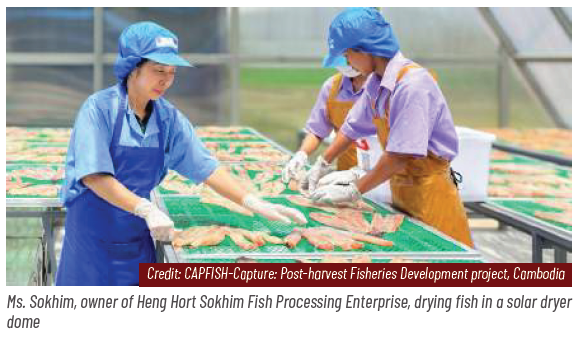
“Before, we relied on sun-drying, and our products often spoiled. With the solar dryer dome, I can produce clean, high-quality fish consistently. Customers trust my products now, and my income has doubled.” — Ms. Sokhim, Heng Hort Sokhim Fish Processing Enterprise.
Partnerships and policy support
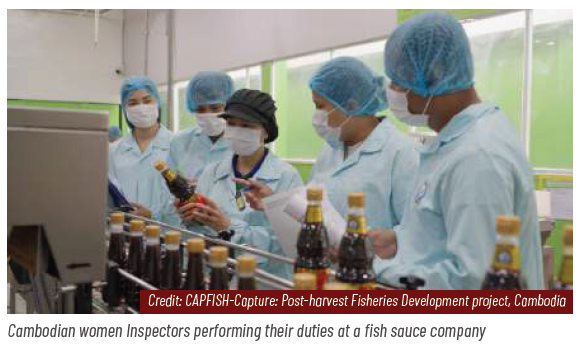
The project’s success reflects strong collaboration among UNIDO, EU, FiA, academia, and private sector partners. Gender mainstreaming guidelines were integrated into project outputs and activities, contributing to the FiA Gender Action Plan (2024–2030). Among 27 food safety auditors, 22% are women playing an essential role in technical support.
Policies such as the Environmental and Social Management Plan (ESMP) embed gender equality safeguards, ensuring compliance across valuechain investments. These frameworks institutionalize gender equality, making it a permanent feature of fisheries development.
Looking ahead: scaling and replication
With over 17,800 jobs created or retained (52% held by women), the CAPFish project demonstrates scalable impact. Lessons learned emphasize the importance of baseline gender analyses, capacity-building, and embedding gender requirements into regulatory frameworks.
Future initiatives can replicate this model across other provinces and sectors, advancing inclusive industrial development and empowering women entrepreneurs. The success of women-led enterprises in accessing international markets shows that Cambodian fisheries can compete globally when supported with innovation and gender-sensitive approaches.
Conclusion: a story of transformation
The CAPFISH-Capture: Post-harvest Fisheries Development project showcases how innovation and gender-sensitive approaches can transform Cambodia’s fisheries sector. By modernizing dried fish processing, empowering women, and strengthening market access, the project has created a foundation for sustainable, inclusive growth.
Women are no longer confined to the bottom of the value chain—they are leaders, innovators, and role models driving progress in Cambodia’s fisheries. Their stories of resilience and success demonstrate that when women are empowered with knowledge, technology, and recognition, entire communities thrive.
The lessons learned from this project highlight the importance of integrating gender considerations into every stage of development. From policy frameworks to practical tools, from training programs to market access, gender equality must remain at the heart of fisheries modernization.
As Cambodia looks to the future, the empowerment of women in fisheries stands as a powerful example of how inclusive development can drive economic growth, social transformation, and sustainable progress.
Acknowledgements
This article is prepared under the CAPFish programme with funding support from the European Union. The authors gratefully acknowledge the continued guidance and support of Dr. Shetty Seetharama Thombathu, Senior Technical Adviser, whose leadership and technical insights were instrumental in advancing gender empowerment initiatives under the project. Sincere appreciation is also extended to the Fisheries Administration for their close collaboration, institutional support, and commitment to promoting inclusive and sustainable development in the sector.
Disclaimer: The contents of this article are the sole responsibility of the CAPFISH-Capture project and the authors and do not necessarily reflect the views of the European Union or UNIDO.
ADVERTISEMENTS