Article II 2/2026 - BLUE ECONOMY ANCHOR: INDIA’S EEZ RULES MARK A NEW ERA FOR SUSTAINABLE FISHERIES
By P Krishnan, Rajdeep Mukherjee, Rishi Sharma and M Krishnan
With the release of the “Sustainable Harnessing of Fisheries in the Exclusive Economic Zone of India Rules, 2025”, India has finally filled a longstanding regulatory gap with regard to fishing in the Exclusive Economic Zone (EEZ). The new legislation is expected to enable more equitable development of India’s small-scale and artisanal fishing communities. The challenges ahead lie in the implementation and Federal coordination of the Rules, as well as credibility with markets and neighbours alike.
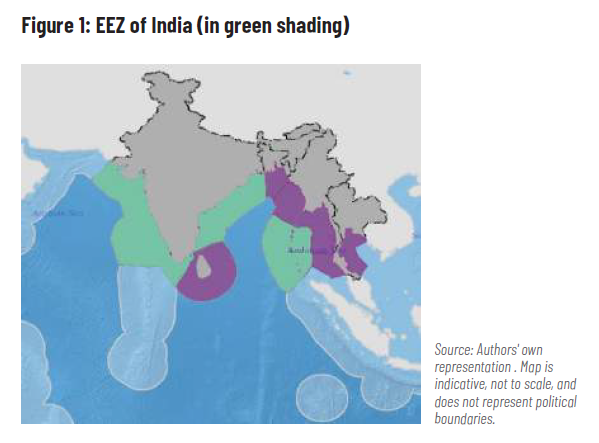
The Government of India marked a significant milestone on November 4, 2025, by notifying the “Sustainable Harnessing of Fisheries in the Exclusive Economic Zone of India Rules, 2025”. These Rules, enacted under the power vested by the Territorial Waters, Continental Shelf, Exclusive Economic Zone and Other Maritime Zones Act, 1976, establishes a formal regime for the exploration, exploitation, conservation, and management of fishery resources within India’s Exclusive Economic Zone (EEZ), which is the area spanning 12 to 200 nautical miles from the coast. The new legislation applies to all fishing and fishing-related activities in the Indian EEZ (Figure 1) and, crucially, resolves the long-standing question of who manages the zone.
As per the Constitution of India, fisheries management in the territorial waters (up to 12 nautical miles) comes under the purview of coastal States and islands, each of which has its own Marine Fishing Regulation Act (MFRA) covering fishing activities within that area of sea. In the absence of any other binding law, fishing activities in the Exclusive Economic Zone (EEZ)—the area extending beyond the territorial waters up to 200 nautical miles—have in the past been largely guided by the limitations set under the MFRA of the corresponding State where the fishing vessel is registered and licensed, thus creating a de facto legal vacuum.
These Rules introduced several key innovations, most notably the transformation of EEZ fisheries from a de facto open-access system to a strictly regulated framework. This was achieved through a mandatory access pass for all mechanised vessels, as well as motorised vessels exceeding 24 metres or those engaged in targeted tuna fishing.
Additionally, the Rules mandate the development of Fisheries Management Plans (FMPs) rooted in an ecosystem approach. This ensures that harvesting levels remain consistent with the Maximum Sustainable Yield (MSY) of the EEZ.
The Rules also resolve long-standing industry debates, specifically regarding LED light fishing. Although the use of LEDs gained popularity over the last decade, it faced significant opposition from environmental groups and traditional fishers, leading to multiple legal challenges. By codifying the existing ban, the Central Government has moved beyond temporary notifications to establish a definitive legal stance.
Overview of the marine fisheries sector of India
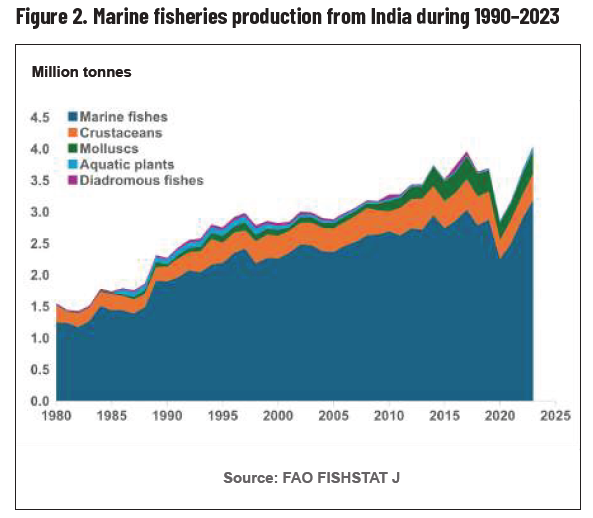
India is the fifth largest country in global marine capture fisheries with a reported production of 3.98 million tonnes in 2023. The production seems to be plateauing with reported output hovering between 3–4 million tonnes per annum (Figure 2).
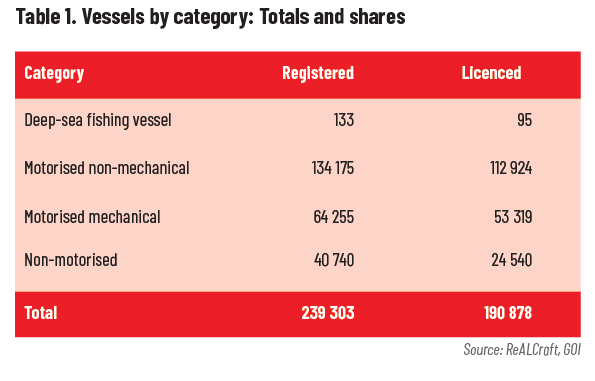
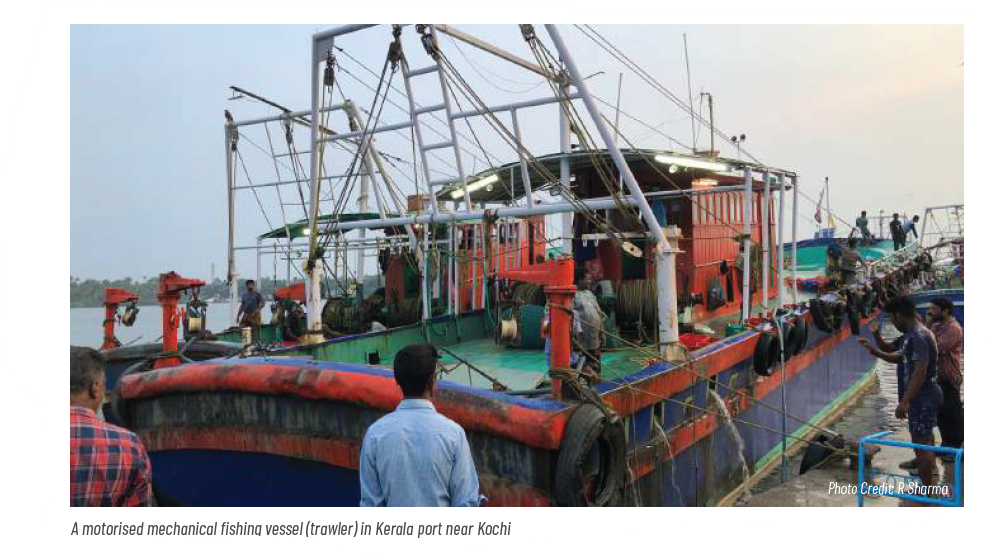
Traditionally, India is a coastal fishing nation and fishing is concentrated on the territorial seas. The fishing fleet is dominated by motorised nonmechanical craft, which accounts for about 56 percent of the total fleet (Table 1). This is followed by motorised mechanical vessels, constituting about 27 percent of all fishing craft. Non-motorised vessels form a significant but smaller segment accounting for roughly 17 percent of the fleet and reflecting the continued presence of traditional and artisanal fishing practices. Deep-sea fishing vessels represent a very small and specialised segment, with only 133 vessels, together accounting for less than one percent of the total fleet. Overall, the fleet structure is heavily skewed towards small- and medium-sized motorised craft operating in coastal waters, with relatively limited participation of large, ocean-going vessels.
While most of the fish stocks assessed in India have been found to be sustainable (Kumar et. Al. 2024)1, the Government has long been concerned about the concentration of fishing effort in the near-shore waters. The National Policy on Marine Fisheries, 2017 (NPMF 2017) explicitly calls for development of deep-sea/offshore fisheries (especially oceanic tuna and allied resources) while reducing excessive pressure in inshore waters. NITI Aayog’s report “India’s Blue Economy: Strategy for Harnessing Deep- Sea and Offshore Fisheries”2 frames deep-sea fisheries as a key growth area, highlighting potential in the broader Central Arabian Sea and other offshore grounds for tuna, seerfish, billfish and deep‑water resources. Subsequently, various government initiatives such as the Blue Revolution Scheme, Pradha Mantri Matsya Sampada Yojana (PMMSY) and the Fisheries and Aquaculture Infrastructure Development Fund (FIDF) have supported development of fishing in offshore waters.
Significance of the new legislation
This regulatory move is timely and critical. During the last seven decades, India has catapulted from an artisanal coastal fishery to one of the top five marine fishing nations in the world. This transformation, while attributed to technological innovation, was also fueled by gaining access to the EEZ through the United Nations Convention on Law of the Sea of 1982 (UNCLOS), pursuant to the 1976 Act. UNCLOS came with both rights and responsibilities for all countries involved in the treaty. However, in India, the management regime remained confined to the territorial waters (baseline to 12 nautical miles), primarily aimed at conflict resolution between different gear groups.
Further, while fisheries come under the purview of both State (for territorial waters) and Union (for the EEZ) Governments, the latter’s Fisheries Division has historically played a passive role. Though some may argue that the fishery sector is mostly limited to the territorial waters, India is also party to various global sustainability conventions, making it imperative for the country to take comprehensive measures relevant to areas beyond coastal territories.
The gradual expansion of domestic fishing into the EEZ, growing international concerns over sustainability and IUU fishing, and the transformation of the Fisheries Division into a full-fledged Department of Fisheries under its own Ministry, made this issue a higher priority. Further, India’s strategic thrust on the Blue Economy, which prioritises harnessing the ocean economy while maintaining ecosystem health, created the necessary political and policy push for this regulatory regime, resulting in the “Sustainable Harnessing of Fisheries in the Exclusive Economic Zone of India Rules, 2025” legislation.
The Rules could ensure that India, as a coastal State, better meets its commitments to international conventions, including UNCLOS. Furthermore, these Rules also provide a mechanism for India to work with neighbouring countries and regional fisheries bodies, such as the Indian Ocean Tuna Commission (IOTC) and the Bay of Bengal Programme Inter-Governmental Organisation (BOBP-IGO) to better manage shared fish stocks like tuna and mackerel, and emerging squid fisheries, which are prime candidates for future growth in India’s fisheries sector.
Apart from resource conservation, proper implementation of the new Rules can also empower the small-scale fishers of the country. The ecosystem principles contained therein particularly emphasise co-management by all stakeholder groups, ensuring that the interests of marginalised groups are taken into account.
Secondly, recognising that India’s presence in high-seas fishing is minimal, the Rules are crucial for boosting deep-sea fishing investment. They provide investors with regulatory certainty, functioning as a vital risk-mitigation and value-creation mechanism essential for accessing premium export markets and fostering stability for major capital expenditure. This, in turn, provides expanding opportunities for the fisheries sector in India.
The commitment to science-based management and the move towards a limited entry model—unlike the de facto open access of the past—assures investors of long-term returns and potential future opportunities, such as trading licences and ITQ systems for individual quotas in the open ocean sector beyond 12 nautical miles. By stipulating a high threshold of compliance, the Rules will effectively promote the building of larger fishing vessels (24 metres and above), while filtering out unregulated, high-risk operators (including foreign fleets) that compromise long-term sustainability.
The way forward
With the adoption of the EEZ Rules, New Delhi’s Blue Economy goals have become legally enforceable. To genuinely exercise India’s sovereignty, the way forward requires a systemic shift. Furthermore, the implementation process necessitates revising fisheries-related legislation to standardise regulations across the country. A critical next step involves close coordination between the Union Department of Fisheries and the fisheries departments in coastal States. This is to ensure that local enforcement agencies are trained and equipped to monitor compliance effectively, especially at the interface between territorial waters and the EEZ; and to monitor landings between these sectors to understand the dynamics of the fishing fleets and the resource sustainability.
Finally, as global fisheries move toward an evidence-based 100 percent compliance model for trade, these Rules demonstrate India’s determination to be globally responsible. This is essential for ensuring that Indian exports come from sustainably harvested landings and avoid future disruptions. The new Rules allow India to speak with one consistent and authoritative voice offshore and at the port gate.
Finally, as global fisheries move toward an evidence-based 100 percent compliance model for trade, these Rules demonstrate India’s determination to be globally responsible. This is essential for ensuring that Indian exports come from sustainably harvested landings and avoid future disruptions. The new Rules allow India to speak with one consistent and authoritative voice offshore and at the port gate.
References
-
Kumar, R., Dash, G., Muktha, M., Sasikumar, G., Ganga, U., Kizhakudan, S. J., … & Gopalakrishnan, A. (2024). Assessment of marine fish stocks within India’s Exclusive Economic Zone: Status report 2022. Indian Journal of Fisheries, 71(1), 1–11.
-
NITI Aayog. (2025). India’s blue economy: Strategy for harnessing deep-sea and offshore fisheries. Government of India. Accessed from https://niti.gov.in/sites/default/files/2025-10/Indias-Blue-Economy-Strategy-For-Harnessing-Deep-Sea-And-Offshore-Fisheries.pdf
ADVERTISEMENTS